Football That Moves Forward — Daiki Higuchi
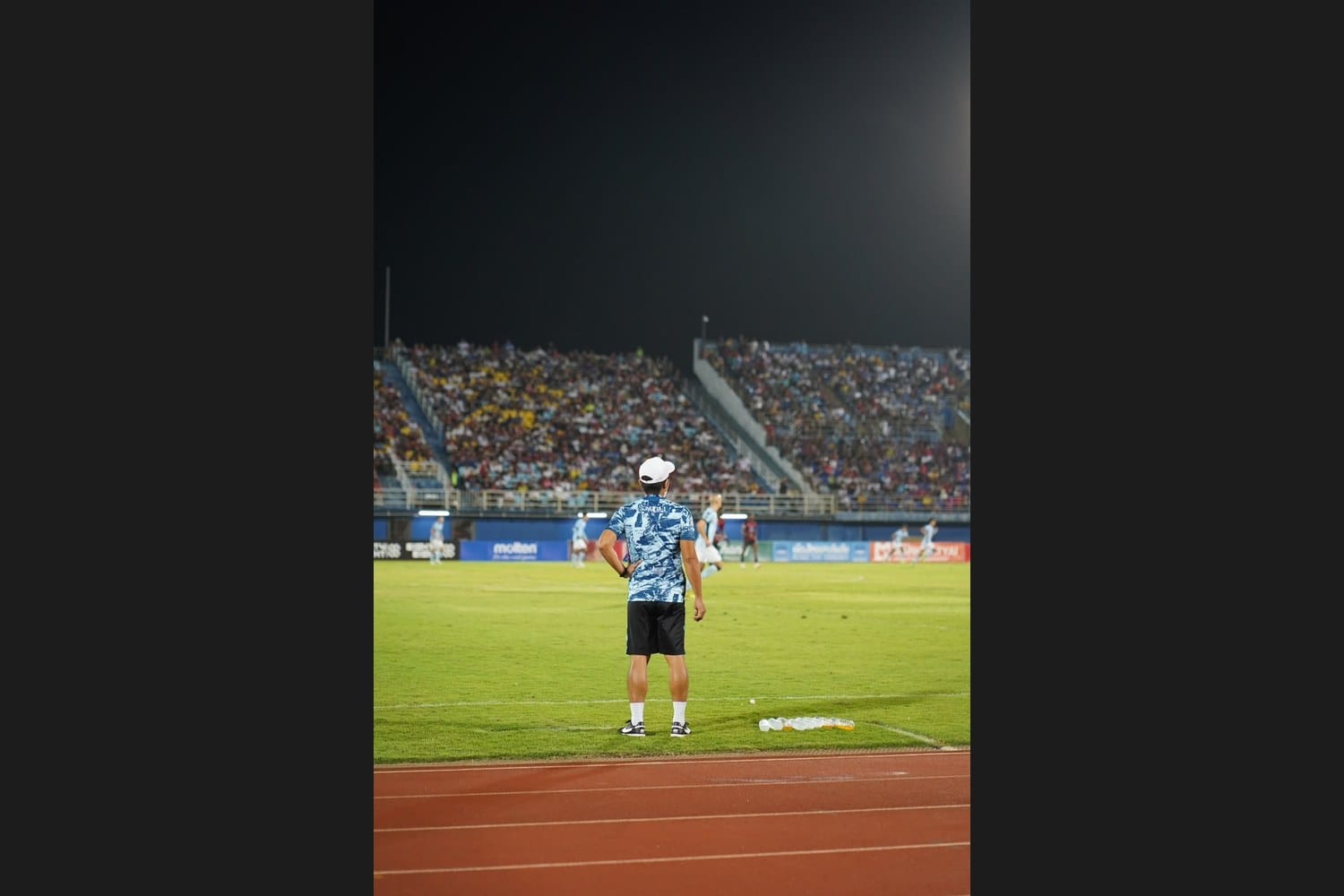
Japanese head coach Daiki Higuchi on a career built entirely in Thailand — Chonburi analyst, Chiangrai into the AFC Champions League, Songkhla head coach to back-to-back Thai L3 Southern titles and promotion. Aggressive and Dynamic Football. Transition 0 Second. Always Look Forward.
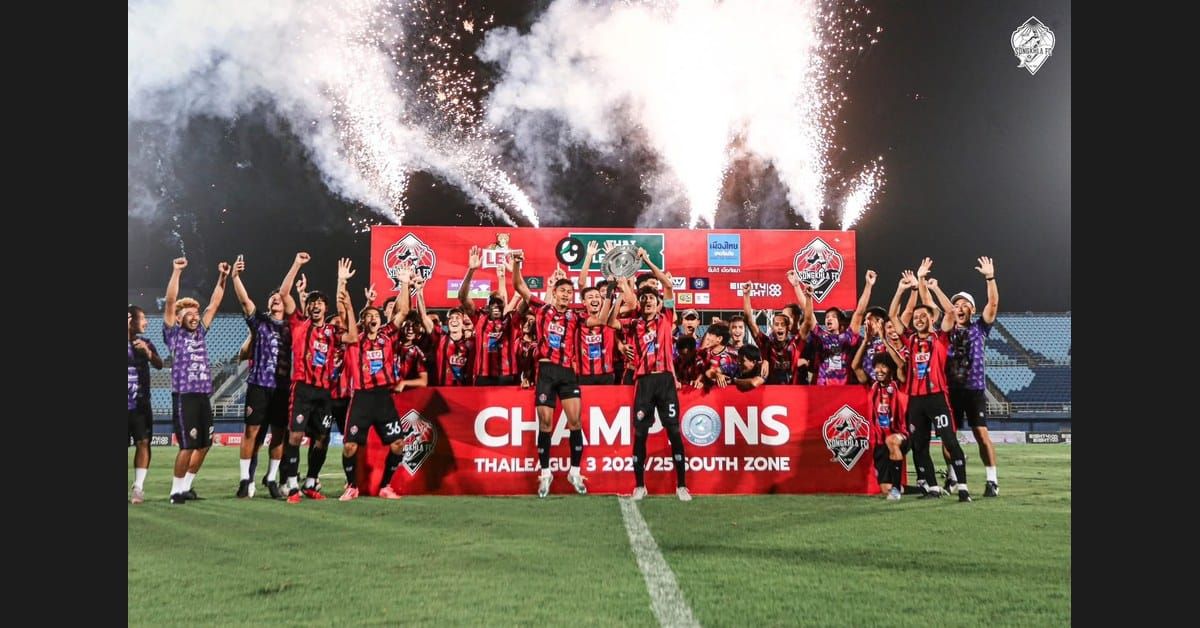
Daiki Higuchi moved to Thailand in 2011, as a player. He was twenty-seven. He played for several Thai clubs, retired in 2018, and began coaching that same year. He has not come back. Chonburi FC analyst and assistant in his first year. Chiangrai United, who had just won Thai League 1, as a staff member the following season — with that staff he won a domestic cup and qualified for the 2020 AFC Champions League, drawn into a group with Melbourne Victory, Beijing Guoan, and FC Seoul. First head-coach role at Songkhla FC in Thai League 3, at thirty-seven. A spell at Phrae United in Thai League 2 as Head of Coaching. A return to Songkhla for a second spell as head coach — and in two consecutive seasons, the Thai League 3 Southern Region championship, the 2024 campaign unbeaten, promotion to Thai League 2, the BGC Cup final, Thai League 2 Coach of the Week at Matchday 4. AFC qualifications all the way up: JFA C and B, then AFC A, now the AFC Pro Diploma, expected 2027.
The reason he did this in Thailand, not Japan, he answers in a single line in Q1 of the exchange below: "Even though I am Japanese, I chose to begin my coaching career in Thailand because I had always wanted to become an international football coach." The reason his teams play the way they do, he answers in the last line of the same question: "Aggressive and Dynamic Football." Across the twenty-four questions that follow, those two sentences are the whole thesis. The first explains why he is in Southeast Asia and in the AFC coaching pathway rather than at home. The second explains what he asks of a team on the pitch — compressed in two named principles he returns to again and again: Transition 0 Second out of possession, Always Look Forward in possession, a 1-2-4-3-1 attacking structure that becomes a 1-4-2-2-2 defensive block, central overloads, forward pressing, line-breaking passes.
In the written exchange that follows, Daiki walks through how aggression and dynamism coexist rather than contradict, why "a principle is not a rule" in the hands of his players, how session design embeds Transition 0 Second in the body before it reaches the mind, how 1-2-4-3-1 bends to the characteristics of the squad in front of him, what the unbeaten season taught him when it ended in a play-off defeat during Ramadan, how he developed Sorawat Phosaman and Nopparut Raksachom into Thailand U-23 call-ups along two completely different pathways, how the 2020 AFC Champions League group with FC Seoul shaped the way he still analyses opponents today, and — in Part 10 — what kind of K League club and what kind of squad he would want if a call came from Korea tomorrow. The title line is from Q1, and is the one line of the exchange that explains everything else: "Aggressive and Dynamic Football."
What follows is a written exchange, published in his own words and in the order he answered them.
Japanese head coach · AFC Pro Diploma in progress · three languages · Thai League career since 2019
MOST RECENT ROLE
Head Coach, Songkhla FC (Thailand) · 2024–2026 second spell
COACHING CAREER
- 2024–2026 · Songkhla FC (Thailand) · Head Coach (second spell)
- 2023–2024 · Phrae United (Thailand, Thai League 2) · Head of Coaching
- 2021 · Songkhla FC (Thailand, Thai League 3) · Head Coach (first spell)
- 2020 · Chiangrai United (Thailand) · Staff — Thai Champions Cup winner · AFC Champions League group stage (Melbourne Victory, Beijing Guoan, FC Seoul)
- 2019 · Chonburi FC (Thailand) · Analyst and Assistant Coach
HONOURS AND SELECTED MILESTONES
- 2024–25 · Thai League 3 Southern Region champions · Songkhla FC · promotion to Thai League 2
- 2023–24 · Thai League 3 Southern Region champions · Songkhla FC · season unbeaten
- 2024–25 · BGC Cup runner-up · Songkhla FC
- 2025–26 · Thai League 2 Coach of the Week · Matchday 4 · Songkhla FC
- 2019–20 · 2020 AFC Champions League group stage · Chiangrai United staff
- 2019–20 · Thai domestic cup winner · Chiangrai United staff
QUALIFICATIONS
- AFC Pro Diploma — in progress, expected completion 2027
- AFC A Diploma
- JFA C and B Licenses — Japan Football Association
- Bachelor's degree in Sports Science — Fukuoka University
PART 1 · ORIGINS
Please introduce yourself briefly to Korean readers. If you had to define your football philosophy in a single sentence, what would it be?
My name is Daiki Higuchi. I am 42 years old and a Japanese football head coach.
Back in 2011, I had the opportunity to move to Thailand and play professionally. I played for several clubs in Thailand before retiring in 2018, which was when my coaching career began.
In my first year as a coach, I joined Chonburi FC, where I worked as an analyst and assistant coach. The following year, I moved to Chiangrai United, who had won the Thai League the previous season. During my time there, we won a domestic cup competition and qualified for the 2020 AFC Champions League.
After leaving Chiangrai, I received my first opportunity to become a head coach at Songkhla FC in Thai League 3. I was 37 years old at the time. After my first spell at Songkhla, I moved to Phrae United in Thai League 2 as Head of Coaching.
I later returned to Songkhla for my second spell as head coach. We won the Thai League 3 Southern Region championship in two consecutive seasons, reached the final of the BGC Cup, and eventually achieved promotion to Thai League 2.
Even though I am Japanese, I chose to begin my coaching career in Thailand because I had always wanted to become an international football coach.
Football is a global sport, and I believe the coaching market is global as well. Working internationally means competing with coaches from other countries and many other football backgrounds. But I enjoy that challenge, and I am happy to continue building my career in international football.
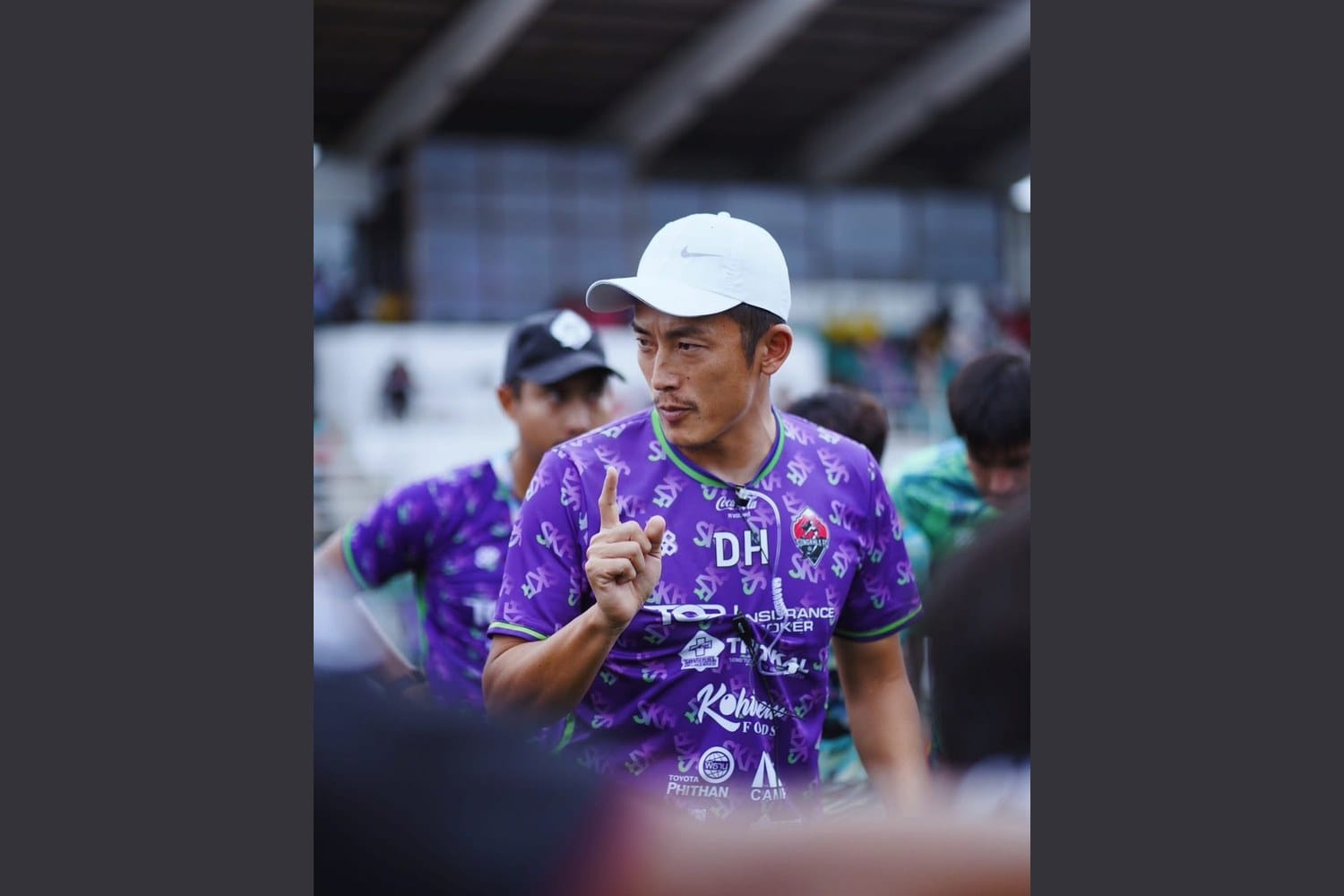
If I had to describe my football philosophy in one sentence, it would be:
"Aggressive and Dynamic Football."
"Aggressive and Dynamic Football."
PART 2 · HOW IDENTITY FUNCTIONS
You've positioned "Aggressive and Dynamic Football" as your playing identity. Aggression and dynamism typically exist in tension with one another—aggression demands structure while dynamism requires fluidity—could you paint a specific on-pitch scenario where these two elements operate simultaneously?
I don't see aggression and dynamism as being in tension with each other. For me, they are connected and exist together throughout the game. Aggression mainly defines how we play out of possession, while dynamism defines how we play in possession.
When we don't have the ball, I don't want my players to be passive and just watch the ball. We use clear pressing triggers and identify specific areas where we want to press and win the ball. The purpose is not only to stop the opponent, but to regain possession in areas where we can create scoring opportunities.
Once we win the ball, our aim is not just to keep possession. We possess the ball with purpose — to break lines and move forward. When a player receives the ball, the first priority is to look forward and play forward. At the same time, the players around the ball move to create dynamic situations and numerical advantages such as 2v1s or 3v2s.
We have specific principles to create these situations. For example, we always provide diagonal support behind the ball, which gives the player vertical passing options. We also encourage diagonal passes followed by lay-offs to help us break lines and progress forward. These movements continuously create dynamic situations and advantages as we move up the pitch.
So aggression and dynamism are connected. We aggressively try to win the ball, and when we have it, we dynamically create advantages to break lines and move forward. That is how our playing identity is expressed on the pitch.
Among your four core principles, "Always Look Forward, Run Forward" appears to constrain backward passes. If a center-back under pressure must still look forward, the risk of ball loss increases—does this principle apply equally to all players regardless of position?
Yes, this principle applies to every player in every position. But I want to make one thing clear: a principle is not a rule that forces players to make a certain decision.
In the end, the decision belongs to the player. As a coach, I cannot control every decision or every action on the pitch. Our principles represent our intention of how we want to play, and they help guide the players' decision-making.
If the whole team understands that our first intention when receiving the ball is to look forward, the other players can anticipate what might happen next and prepare their movements to support the player on the ball. This creates a common understanding within the team and also creates team combinations.
So, if a centre-back receives the ball under pressure, "Always Look Forward" does not mean that he must force a forward pass and risk losing possession. He can play backwards if that is the best decision in that moment. The important question is not whether we play backwards, but why we play backwards. We may play backwards to create a better situation to go forward again.
We try to keep possession without unnecessary losses, but our possession always has a purpose. The ultimate purpose is to move the ball forward, break lines, and create more scoring opportunities — not simply to keep the ball.
"Transition 0 second" is a declaration to eliminate thinking time. For a player to react the instant possession is lost, that reaction must already be ingrained in the body—how do you embed this automatic response on the training ground?
I think session design is very important to make the reaction after losing possession automatic.
If we want the players to execute "Transition 0 Second" in a match, we have to create training situations where they repeatedly experience the moment of losing possession and have to react immediately. The session itself should demand that reaction from the players.
At the same time, coaching during the session is also important. Every time we lose the ball, we encourage and reinforce an immediate reaction. Through repetition, the players start to develop it as a habit rather than having to think about what to do.
For me, Transition 0 Second is created through session design, repetition, and consistent coaching. If players do not repeatedly experience and execute these transition moments in training, we cannot expect them to react automatically when the same situation happens in a match.
"If players do not repeatedly experience and execute these transition moments in training, we cannot expect them to react automatically when the same situation happens in a match."
PART 3 · ATTACKING DESIGN
In the 1-2-4-3-1 attacking structure, the spatial arrangement of the four midfielders is crucial. Do these four form a horizontal line, a box shape, or an asymmetric diamond? And is that arrangement fixed or does it vary according to ball position?
The 1-2-4-3-1 attacking structure is just our starting position, and it is very flexible. The main purpose is to create central overloads and provide more vertical passing options.
The positioning is not fixed. It varies depending on the position of the ball, the situation, and also the characteristics of the players.
For example, if a winger wants to stay wide, that is not a problem at all. But then another player needs to occupy the central space. A full-back on that side can move inside to provide another central option, or a number eight can step higher to play between the lines.
So, for me, it is not about whether it's a horizontal line, a box, or a diamond. The shape can change, but the purpose remains the same: to create central overloads and provide vertical passing options.
In your attacking principles you emphasize both central numerical superiority and wide switches simultaneously. Concentrating players centrally leaves the flanks empty, and switching wide requires extracting the ball from the center, so the two principles must be temporally separated—is it a sequential structure where you first create central superiority then switch wide?
My idea is that central superiority and the opportunity to switch the point of attack exist at the same time.
Even when we create central overloads, we always have the opportunity to switch the point of attack because we have more players and more passing routes centrally. We can switch the ball through the central area using short combinations. This can actually help us accelerate the attack because we can draw the opponent to one side or attract their defenders into central areas, which can create more space on the opposite side.
Of course, we can also switch directly. For example, if the opposite full-back steps higher and space becomes available in the opposite wide area, we may switch the point of attack immediately.
Our first priority is to break lines and attack centrally. But if we play wide and the opponent shifts across to protect that area, we can switch the point of attack, move the opponent again, and find free space on the opposite side.
Our aim in the attacking phase is always to create dynamic situations. So, for me, central superiority actually gives us more options to switch the point of attack, either through short combinations or directly.
The principle "Play Forward before Playing Wide" assigns absolute hierarchy to verticality. When opponents congest the center with compact defending and compress forward space, do you demand attempts to progress through tight spaces rather than circumventing via the flanks?
Again, principles are not rules that force players to make certain decisions. Principles are there to help guide the players' decision-making.
However, if a player does not have the courage to play vertically and always avoids that challenge, is that acceptable for me? No. If you don't try, you will never succeed.
Of course, "Play Forward before Playing Wide" does not mean that players must force a vertical pass every time. They have to read the situation and make their own decisions. But I want them to have the courage to look for the forward option first, even when the opponent is compact and the space is tight.
That is why, as a coach, I deliberately create training situations where players have to play in narrow spaces and under pressure. If necessary, I also provide them with ideas and solutions: how to create space, how to drag opponents out of position, how to use third-man combinations, and how to use lay-offs to create the next forward option.
Through these experiences, players become more comfortable and confident in tight situations, and they can apply those solutions in the game.
I believe this is also the coach's responsibility: to provide challenges, provide solutions when necessary, and create an environment where players can grow and develop, both individually and as a team.
Creating 2v1 and 3v2 numerical superiority is a precise numerical target. What is the target zone on the pitch for establishing this superiority? And who executes the final phase of converting that superiority into goals?
Creating dynamic situations is our main attacking concept. For me, 2v1s and 3v2s are not numerical targets for one specific area of the pitch. We try to create these situations across the entire field when we are in possession.
Of course, this concept eventually has to lead to scoring opportunities, so in the final third, creating space is particularly important. If the players without the ball stop moving, new spaces will not appear. That is why I demand movement after the pass. After passing to a teammate, the player should move again — to support, drag an opponent away, create an overload, or open space for another player.
These continuous movements help us create spaces that we can exploit and eventually turn our numerical advantages into scoring opportunities.
So, the target zone is not one specific area. We aim to create dynamic situations across the entire pitch, and in the final third, those situations must ultimately help us create chances and score goals.
PART 4 · DEFENSIVE LOGIC
Transitioning to the 1-4-2-2-2 defensive structure reduces the midfield from four to two. Do the remaining two move forward to form a pressing line, or do they drop to the flanks or back? Does that directional movement vary according to opposition buildup shape?
My idea of the 1-4-2-2-2 defensive structure is that the shape allows us to compress the space on one side of the pitch and create situations where we can win the ball back more effectively.
However, the players' movements are not fixed. They vary depending on the opponent's build-up structure and the game situation.
For example, sometimes our wingers step higher to press the opponent's centre-backs, depending on how the opponent builds up. In other situations, our wingers may track the opponent's full-backs and drop into the same line as our defensive line.
Even when the situation changes, our main concept out of possession — Ball-Oriented Defending — remains the same: press forward, compress the space around the ball, win possession as quickly as possible, and use that regain to create another attacking opportunity.
For me, the structure can adapt to the opponent, but the concept and purpose of our pressing remain the same.
"Control Central & Press Forward" means controlling the center while pressing high, which appears designed to deliberately leave the flanks open to invite the opponent. When opponents bypass via the flanks, is that intentional? Could you explain the specific mechanism by which the wide trap operates?
Before we press, we first have to think about compactness and controlling the central area. If we leave too much space centrally and allow the opponent to play through the middle, they can progress directly towards our goal.
For example, if an opponent's centre-back can play through our first line into the middle, our front four then have to run backwards and press backwards. That is not our intention. We want to press forward.
So, our first task before pressing is to stay compact both laterally and vertically, control the central area, limit the opponent's forward passing options, and guide them towards the wide areas.
Once the opponent plays wide, that is where we intentionally try to win the ball. Our defensive organization shifts towards the ball side, we compress the space, create an overload around the ball, and press together to regain possession.
For example, when the opponent's left full-back receives the ball, our right winger presses him with high intensity. The purpose is to give the full-back no time to look up and find the next option. This makes it easier for our players around the ball to anticipate the next pass — whether it goes inside, to the winger, or behind our defensive line.
This is another important part of our pressing: once we trigger the press, we press with intensity to reduce the opponent's time and limit their options.
So, I wouldn't say that we intentionally leave the flanks open. Our intention is to guide the opponent towards the wide area, compress the space around the ball, limit their options, and win possession.
That is the mechanism behind our principle of "Control Central & Press Forward."
You've specified compression as a defensive principle—what is the final destination point where you aim to compress the opponent? The wide touchline, or a specific central zone? Once you've driven them to that point, who decides the timing to win the ball?
When we compress the space on the ball side, the key is the intensity of the pressure on the ball. The first defender has to close down as much as possible to reduce the opponent's time and limit their passing options.
Once we do that, the opponent's next action becomes more predictable. Whether they play inside, down the line, or try to play behind us, the next defender can anticipate that action and be ready to step in and win the ball.
So, for me, compression is not simply about driving the opponent towards one specific destination. It is about compressing the space around the ball and using pressure on the ball to reduce the opponent's options and make their next action more predictable.
At the same time, the final decision-making always belongs to the players. Whether we go to press or not is also part of their decision-making. They have to read the situation and decide the right moment to step in and win the ball.
Especially in our middle and high blocks, there are certain moments when the priority is to win the ball, not simply to delay the opponent.
Of course, as a head coach, I provide clear pressing triggers — when to press and how to press — so that the whole team shares the same picture and can press forward together.
You stated the first pass after counter-pressing is always forward. The moment you regain possession through counter-pressing, space or teammates must already be prepared ahead—do certain players hold positions for attacking transition even during the defensive phase?
Basically, in our defensive phase, I demand that our defensive block maintains compactness even when we defend in a low block. Our first pressing line also has defensive responsibilities. For example, our number 9 and number 10 have to protect the space in front of our midfielders and stay connected to the defensive block.
But there is also an attacking advantage to this positioning. When we intercept the ball and regain possession, those two players are already in positions where they can exploit the space in front of the opponent's defensive line. If we can find them immediately after regaining possession, we can accelerate the attack and create a fast counter-attack.
For example, many number 9s or number 10s immediately want to use the wide areas after winning the ball. But my idea is different. Before exploiting the wide space, I want us to use the central area and attract the opponent's defenders towards the center. Then we can attack the space that opens up out wide.
One of our attacking-transition principles is to play forward first and try to finish within 10 seconds. So our first intention after regaining possession is not simply to go wide or secure the ball. We first look for the opportunity to play forward, accelerate the counter-attack, and create a scoring chance.
So, to answer the question directly, the positioning of our number 9 and number 10 is part of our defensive compactness, but at the same time, it prepares us for the moment when we win the ball.
PART 5 · SYSTEM VARIABILITY
You mentioned a flexible system based on player characteristics and opponent strength. Are 1-2-4-3-1 and 1-4-2-2-2 adjustable base frameworks? If you've changed the structure itself—for example switching to a back three—could you explain the background to that decision?
The final decision always depends on the characteristics of the players, the strengths of the opponent, and the game situation.
For example, in our 1-2-4-3-1 attacking structure, I may normally ask the wingers to occupy the half-spaces and play in narrow areas. But if I have a winger whose biggest strength is his individual quality in wide areas, and I force him to play inside, I cannot guarantee that he will be able to show his maximum potential.
In that case, I may allow him to stay wide and ask another player to occupy the inside space. The positions and structure can change, but we still maintain the purpose of creating central overloads and providing vertical passing options.
At one of my previous clubs, for example, I used a 1-3-3-4 attacking structure. One of our wide players stayed wide because his strengths were his speed, technique, and ability to beat opponents one-on-one. But if he stayed wide, someone else had to occupy the central space. So we adjusted the structure: the left-back moved into the back three, while the right-back inverted into a more central position.
This is why I see structure as flexible. I also have to adjust our tactical approach according to the opponent and the situation during the match. I am willing to change the structure, even during a game, if it gives us a better solution against the opponent.
This is also the reality that head coaches often face. When you take over a team, you usually cannot select the entire squad yourself. You have to work with the players you have. If I insist on my preferred system when I don't have players who fit that system, I think it becomes very difficult for the team to be successful.
So, for me, the structure is adaptable, but our playing identity and core principles must remain consistent.
The principle of creating numerical superiority through dynamic movement means players are not fixed. But excessive fluidity can collapse structure—does a boundary exist defining "move only this far"? How do you make players cognizant of that boundary?
I don't want to give the players strict positional boundaries, especially in the final third. I want them to have the freedom to express their creativity.
But freedom does not mean that players can move anywhere without purpose. For example, it doesn't mean that the right full-back can suddenly move all the way to the left-wing position.
For me, dynamic movement always has a purpose. When the ball carrier receives the ball, the players around him have to provide options. Their movements should help us create situations such as 2v1s or 3v2s, give the ball carrier more solutions, and make it more difficult for the opponent to defend.
Rather than setting strict positional boundaries, I prefer to give each position clear tasks and responsibilities in each phase of the game. For example, when we break through in a wide area, the opposite winger has the responsibility to attack the second post, while a number eight may also have the responsibility to arrive in the box.
So, we don't have strict positional boundaries, but every position has specific tasks and responsibilities. The players have to understand why they move and why they occupy a certain space.
Freedom and creativity must still contribute to creating advantages and scoring opportunities. Our attacking movement is flexible, but it must always have principles and a purpose.
PART 6 · COMPETITIVE VALIDATION
The 2023/24 Thai League 3 unbeaten championship is evidence of both tactical completeness and mental management. What was the most critical match that season, and if there was a specific adjustment that produced a draw or comeback victory, what was it?
In Thai League 3, we first competed in the Southern Region, where we finished as unbeaten champions. The top two teams from each region then qualified for the promotion play-offs, with the opportunity to earn promotion to Thai League 2.
We started the play-offs by winning our first game, but then we lost the second match against a team we were not expected to lose to. That was probably the most critical match of our season.
Until that point, we had been unbeaten and had built a lot of confidence and momentum. So that first defeat was a big shock—not only for the players, but also for myself and everyone around the club.
At the same time, the play-offs took place during Ramadan. We had 90% Muslim players in the squad, and managing their physical condition and maintaining consistent performance during that period was another challenge. Looking back, I think we could have managed both the physical and mental sides of that period better.
The biggest problem was that we did not recover strongly enough from that first defeat. We had been a very strong team throughout the season, and I was very confident that we could achieve promotion. But after that loss, we struggled to regain the same momentum and mentality.
In the end, one defeat changed the direction of our play-off campaign, and we did not achieve promotion that season. It was a painful experience, but it taught me an important lesson: being unbeaten and successful for a long period does not guarantee what happens next. As a head coach, you also have to prepare the team to respond when the first setback comes.
Two consecutive Thai League 3 Southern Region championships. After the first title, opponents would have studied your tactics and prepared countermeasures—were there elements you added or changed in the second season to neutralize those responses?
In my first season at Songkhla, I don't think many people expected us to win the Southern Region and qualify for the promotion play-offs. The club had reduced its budget, and we built the squad with many young players from the South. Because of that, I think many opponents underestimated us.
In that first season, we focused more on strong defending and quick transitions, and that worked very well for us.
But in the second season, the situation was different. Opponents had already analyzed our football and prepared specifically against us. So we also had to evolve. Especially when we had more possession, we needed to become better at creating chances ourselves instead of relying mainly on transitions.
We worked with the players on how to create and exploit space, how to progress into the areas we wanted to attack, and how to turn those situations into scoring opportunities. I think those additional elements worked very well.
We also had many injuries during the season, but other players stepped in and performed well. They were highly motivated and ready to contribute, which showed the strength and depth we had developed within the team.
So, I think the first season gave us the foundation, and in the second season we added the extra elements we needed to evolve. We didn't completely change our football. We developed it because the opponents had also adapted to us.
Across 105 matches you've recorded a 53% win rate. A stable but not overwhelming figure—analyzing the other 47% of matches, was there a common pattern where the game model failed to function? Was it player resource limitations, or opponent responses?
The 53% win rate across 105 matches is the overall number across three seasons, so I think it's important to understand the context behind that figure.
In our first two seasons, we competed in Thai League 3, and our win rate was close to 60%. After achieving promotion in the second season, we moved up to Thai League 2 for the third season, where the level of competition was obviously different.
At the same time, many of our players were still the same players who had competed with us in Thai League 3. There were clear gaps in the technical, tactical, and mental demands of the league. Even with limited resources, however, we tried to maintain our playing identity and adjust our game model and plan.
In fact, after 12 matches in Thai League 2, we were in sixth position, so I felt that we were competing well at that level.
Then a severe flood hit the city. We were unable to train for around 10 days, three matches were postponed, and the rescheduled fixtures meant that we later had to play seven matches within 17 days. It became an extremely difficult period for us physically and mentally, and we also had to play those matches away from home.
After that disruption, we struggled to recover our previous momentum and level of performance, and our position in the table dropped significantly.
So when I look at the matches we didn't win, I wouldn't identify one simple tactical pattern or say that our game model suddenly stopped working. There were different factors across the three seasons. The step up from Thai League 3 to Thai League 2 increased the demands on our players, while limited resources and, later, an exceptional disruption caused by the flooding also affected our ability to maintain consistent performance.
For me, the important lesson was that a game model and game plan have to work within the reality of the players, the level of competition, and the circumstances surrounding the team.
PART 7 · PLAYER DEVELOPMENT
Sorawat Phosaman, 23, and Nopparut Raksachom, 22, were called up to the Thailand U-23 national team. Comparing when these two joined the squad to just before their call-ups, which abilities grew most significantly? Could you detail the training methods or coaching interventions that drove that growth?
Sorawat Phosaman and Nopparut Raksachom had completely different personalities, so as a coach, I had to find a different approach for each player.
Sorawat is a goalkeeper and a very humble, hard-working player. He already had good professional habits. He took care of his body, his nutrition, and did specific gym work for goalkeepers. For him, I felt that what he needed most was playing time and the right opportunity.
In his first season, he was our substitute goalkeeper, but after discussions with my goalkeeper coach, we decided to give him opportunities in the cup competitions. We competed in three cup tournaments, so he was able to gain valuable playing experience.
In the second season, after further discussions with my goalkeeper coach, we decided to make him our first-choice goalkeeper. His first game was actually very difficult and he made several mistakes. But for me, developing young players also means creating an environment where they are allowed to make mistakes and learn from them.
Sorawat was humble and had a strong desire to improve, so he learned from those experiences. He eventually played every league game that season. At that time, the Thailand U23 national team had a Japanese head coach, so I asked him to watch Sorawat and consider giving him an opportunity. Eventually, Sorawat earned his opportunity with the U23 national team.
Nopparut was completely different. He was already a well-known young player and had always been considered an important player in his teams, so he was very confident. But his off-the-pitch habits and discipline were not at the same level. He would sleep late, wake up late, and suffer many minor injuries, which affected the consistency of his training and performances.
So before developing him as a footballer, I felt I first had to help him understand what it means to be a professional player.
I remember one friendly match when we had set a specific time to start the warm-up, and he was the only player who arrived late. I told him to go home and did not allow him to play in the match. Afterwards, he came to apologize, and I used that moment to speak with him. I told him, "If you don't develop good discipline and good habits, you cannot become the player you have the potential to be."
After that, I saw a real change in him. He started working harder in the gym, communicating with our fitness coach, and learning how to take care of his body and prevent injuries. Once I saw that change in his mindset and habits, I waited for the right moment to give him his opportunity.
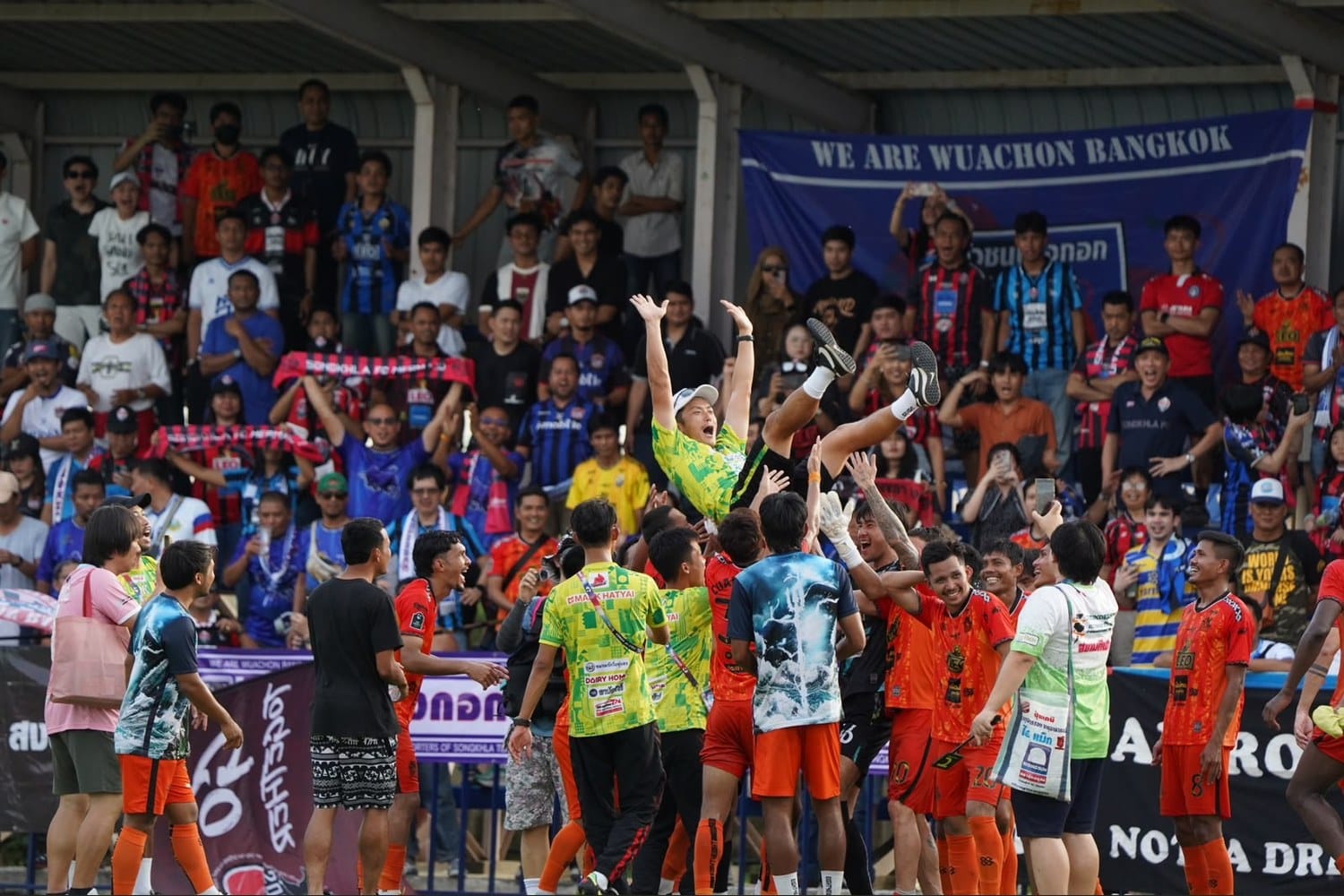
That moment came during the promotion play-offs. We were 1–0 down and one of our midfielders was struggling, so I brought Nopparut on during the first half. Within one minute, he scored the equalizer. He went on to produce an excellent performance, and from that match onwards, he became a regular starter.
These two players taught me something very important about player development. Every player needs a different approach. Sorawat needed trust, playing time, and patience. Nopparut first needed discipline, better professional habits, and then the right opportunity.
As coaches, we need to understand each player's personality, habits, and individual needs, and then find the right way to help that player develop. For me, that is one of the most important responsibilities of coaching.
"Sorawat needed trust, playing time, and patience. Nopparut first needed discipline, better professional habits, and then the right opportunity."
PART 8 · METHODOLOGICAL ROOTS
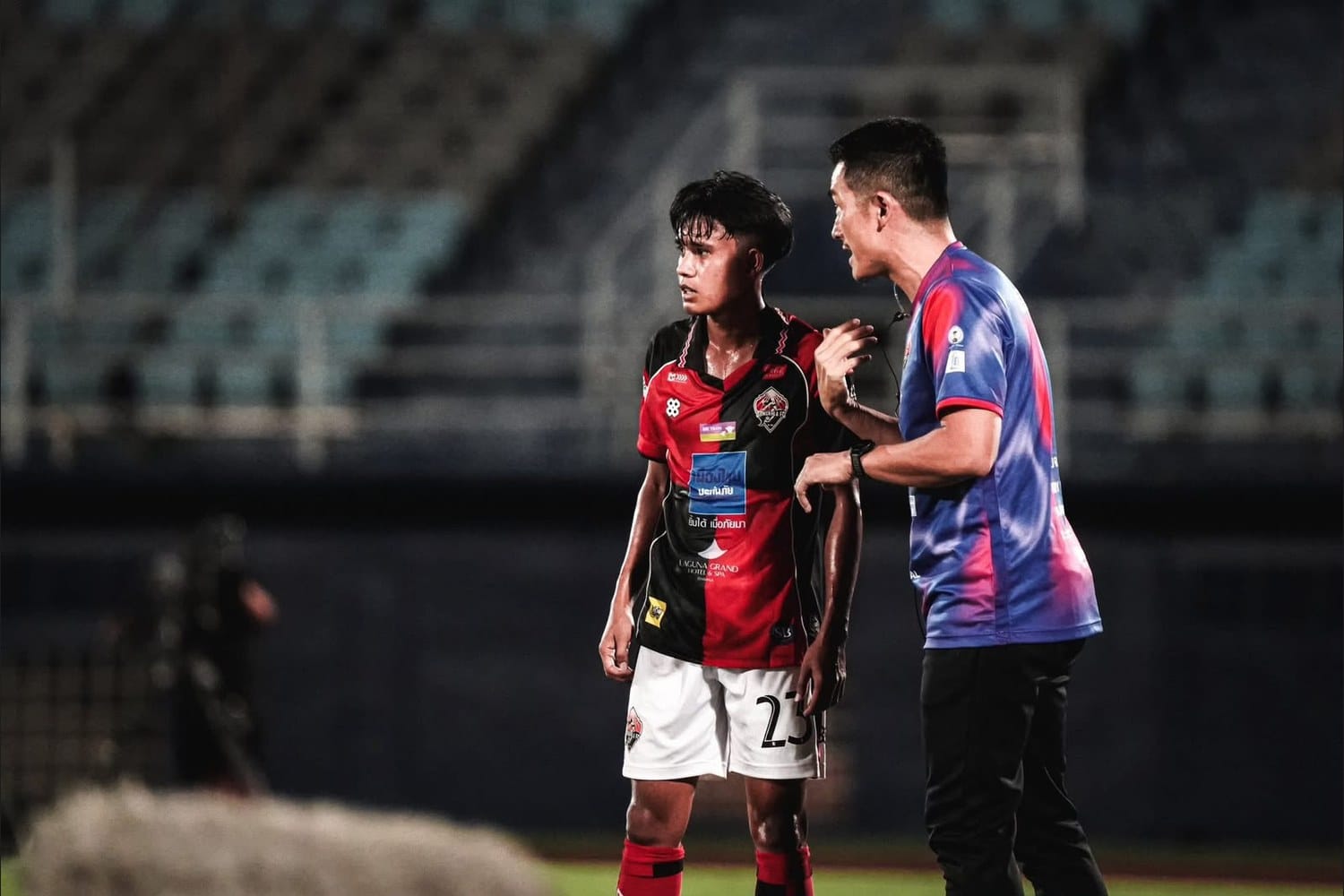
You began your career as an analyst at Chonburi FC. Managers with data analysis backgrounds tend to read matches numerically—do you still use data in opposition analysis or match preparation? If so, which metrics do you prioritize?
I don't rely heavily on data for opposition analysis or match preparation. I mainly use data after matches to evaluate our own team's performance and whether we have successfully executed our game model.
For example, one of our key attacking principles is playing forward and breaking lines. So after each match, I work with the analyst to measure how many times we successfully break the opponent's lines with forward passes.
We also analyze how many times we enter specific attacking areas, such as the cross zone, D-zone, vital zone, and assist zone, and ultimately how many times our attacking players receive the ball or have opportunities to score in the finishing zone.
These metrics are directly connected to our playing principles. For me, it's not about collecting data simply because the numbers are available. I want to use data to evaluate whether what we are trying to achieve on the pitch is actually happening.
By combining what we see in the match with these performance indicators, we can evaluate whether our attacking performance was effective and identify what we need to improve in training.
So for me, data is mainly a tool to evaluate and validate our game model and performance, rather than something that determines how the opponent plays.
You earned a Bachelor's degree in Sports Science from Fukuoka University. Among physiology, biomechanics, and psychology, which field most influenced your coaching methodology? Could you offer an example of how that academic background operates concretely in the field?
I would say that all of these areas have influenced my coaching methodology, rather than one specific field.
In modern football, performance is built through the integration of four key elements: physical, psychological, technical, and tactical. These elements should not be developed separately. They are interconnected and should be integrated into the training process.
What I learned through Sports Science at university gave me the foundation to understand football performance from these different perspectives. More importantly, it became a trigger for me to continue exploring how coaching methodology was developing, particularly in Europe, where there has been a strong movement towards integrating these elements within football-specific training.
This has influenced how I design training today. Rather than separating physical, technical, tactical, and psychological development, I try to create football training situations in which these elements are developed together.
So for me, my academic background did not simply give me knowledge in one specific area. It gave me the foundation and curiosity to keep studying how all the elements of performance can be integrated into the training process.
Your coaching education began with the JFA in Japan and has continued through the AFC, where you are due to complete the Pro Diploma in 2027. Why did you choose to pursue qualifications under both bodies? And is there something from the AFC course that you were able to apply right away in the Thai League?
Let me first explain my pathway. I obtained my JFA C and B Licenses in Japan, followed by the AFC A Diploma, and I am currently working towards the AFC Pro Diploma.
JFA and AFC qualifications are part of the same Asian coaching qualification framework, so my decision was not about collecting qualifications from two separate systems. It was more about where and how I wanted to continue my development as a coach.
My goal has always been to become an international football coach, and I believe the coaching market is global. To work internationally, I think it's important not only to speak English, but also to learn and think about football in another language, discuss football with coaches from different countries, and communicate my ideas through a common football language.
That is one of the main reasons why I chose the AFC pathway. It gives me the opportunity to learn in an international environment and exchange ideas with coaches and coach educators from different football backgrounds.
Of course, I continuously apply what I learn from the courses to my own coaching environment. But for me, the biggest impact is not one specific tactical idea that I immediately copied and applied. It's the continuous process of challenging my own ideas, learning different perspectives, and developing my ability to communicate and coach in an international environment.
For me, the AFC pathway is not simply about obtaining a license. It is part of my development as an international coach.
PART 9 · ASIAN EXPERIENCE
In the 2020 AFC Champions League, Chiangrai were drawn with Melbourne Victory, Beijing Guoan, and FC Seoul. What did analyzing opponents at that level teach you, and how has that experience shaped the way you analyze opponents today?
Before I answer, I should mention that I was not involved in the match against FC Seoul.
The 2020 season was very unusual because of COVID-19. Football and many other parts of society stopped completely. Before the competition was suspended, we played Melbourne Victory away and Beijing Guoan at home. The AFC Champions League was then suspended for several months.
When football eventually resumed, the situation was very different and our performances were not stable. The head coach and I left the club before the matches against FC Seoul, so my own experience in that competition comes from the matches against Melbourne Victory and Beijing Guoan.
However, my experience analyzing opponents in the AFC Champions League had a significant influence on the methodology I still use today.
One of the biggest things I learned was that individual quality can influence the game even more than structure. Of course, we analyzed the opponent's tactical structure, but at that level, the individual qualities and characteristics of the players could completely change what happened within that structure.
At that time, we were one of the weaker teams in the competition, so our first question was: How can we stop the opponent's strengths? We had to understand where the biggest threats were and find ways to control them before thinking about how we could express our own strengths.
I still use this approach today as a head coach. When I analyze an opponent, I first evaluate the quality and characteristics of our players and the opponent's players. Then I compare the two teams and ask whether we can compete on equal terms or whether there is a significant difference in quality.
From there, I decide the strategy before the tactics. If we are weaker, for example, we may need to place more emphasis on defending and neutralizing the opponent's strongest qualities before finding the moments where we can use our own strengths.
For me, opposition analysis is not only about understanding formations and structures. It starts with understanding the players, comparing the level of the two teams, and then building the right strategy for that specific match.
PART 10 · KOREAN CONNECTION
You speak three languages: English, Thai, and Japanese. If a K League club made an approach, what type of club or player profile would best suit your game model—aggressive pressing and zero-second transitions? Do you keep the possibility of K League entry open?
Yes, absolutely. I am very interested in the opportunity to work as a head coach in the K League because the K League is one of the best football leagues in Asia.
Regarding the type of club, the first things I would want to understand are the club's ambition and its target. As a head coach, my responsibility is to win games and help the club achieve its objectives. I am also an ambitious coach with clear targets, so I believe the club and the head coach need to be aligned and work towards the same goal.
In terms of player profiles, of course, when you take over a team, you cannot select the entire squad yourself. You have to understand the players you have and adapt your approach accordingly.
Ideally, for my game model, I like players who are mobile, quick, physically strong, and have the stamina to play with intensity. Mental strength is also very important because our aggressive pressing and zero-second transitions require players to react immediately and repeatedly throughout the game.
At the same time, we are not only a transition team. When we have the ball, we want to keep possession with purpose, break lines, and create chances with creativity. So we also need players with the technical quality and decision-making ability to play effectively in possession.
Therefore, my ideal player is physically capable, mentally strong, and technically good enough to execute our football both in and out of possession.
And if I have the opportunity to work in Korea, I would definitely be interested in taking on that challenge.
"I am very interested in the opportunity to work as a head coach in the K League because the K League is one of the best football leagues in Asia."
PART 11 · VISION
What is your vision and ambition going forward? Among promotion to Thai League 1, a return to Asian continental competition, or a move to another league, which option takes priority? If there is something you are preparing now to prove aggressive and dynamic football on a higher stage, what is it? And how would you like to be remembered as a manager?
My vision and ambition are very clear. First, I want to achieve something as a head coach in a top division. Then, my next ambition is to return to the AFC Champions League, this time as a head coach, and compete at the highest level in Asia.
Honestly, I am not focused on one particular country. I am now close to completing my AFC Pro Diploma, which will open more opportunities for me across Asia. If there is an opportunity where I can achieve something as a head coach, I am willing to go.
I strongly believe that my football identity — Aggressive and Dynamic Football — can be applied at a higher level. Of course, working internationally means competing with coaches from many different countries and football backgrounds. I understand that challenge, but that is exactly the environment in which I want to test myself.
I believe in myself, and I believe in my football identity. I want the opportunity to prove that it can succeed at the highest level in Asia.
For me, building my career internationally is something I genuinely enjoy. I enjoy the challenge of moving into different environments, working with different players and cultures, and continuing to develop myself as a coach.
Ultimately, I want to be known as an international head coach with a clear football identity — a coach who is willing to take on challenges, adapt to different environments, and achieve results.
CLOSING
Read end to end, this exchange is one coherent argument. A single-sentence identity. Two named principles that do the real daily work — Transition 0 Second out of possession, Always Look Forward in possession. A 1-2-4-3-1 attacking structure that is a starting point and nothing more, bending to the players in the room and the opponent across the line. A 1-4-2-2-2 defensive block that compresses, controls the centre, guides wide, and traps. Structure as reference, not prison. Freedom, but freedom with a purpose. A principle is not a rule. And beneath all of it, the session-design logic that makes an automatic reaction automatic, repeated into the body before it is asked of the mind. The method is one idea, applied consistently from Thai League 3 to Thai League 2, and — Daiki himself argues in Part 11 — applicable at a higher level still.
The honours list anchors the method. Thai domestic cup winner with Chiangrai United staff in 2019–20, qualification to the 2020 AFC Champions League, group stage against Melbourne Victory, Beijing Guoan, and FC Seoul. First head-coach appointment at Songkhla FC at thirty-seven, in Thai League 3, Southern Region, with a reduced budget and a squad built from local young players many opponents underestimated. Thai League 3 Southern Region champions in 2023–24, unbeaten across the regional season, a play-off setback during Ramadan that in Part 6 he refuses to explain away. Thai League 3 Southern Region champions again in 2024–25, this time evolving the attacking game beyond transitions and earning promotion to Thai League 2. BGC Cup runner-up in the same window. Thai League 2 Coach of the Week at Matchday 4 the following season. Sixth in Thai League 2 after twelve matches, then a city flood, ten days without training, seven matches in seventeen days, and the honest accounting that followed. Two Thailand U-23 call-ups — Sorawat Phosaman and Nopparut Raksachom — developed along opposite pathways, one by trust and the other by discipline first. JFA C and B, AFC A, and the AFC Pro Diploma in progress for 2027. The itinerary itself is the thesis.
The Korea chapter in Part 10 is deliberate and quiet. Daiki has not yet worked inside the K League. He names it as "one of the best football leagues in Asia," says he is "absolutely" interested, and sets out the squad profile he would want — mobile, quick, physically strong, mentally strong, technically good enough to execute our football both in and out of possession. The broader Asian aggregate underneath is not quiet: three languages (English, Thai, Japanese), eight continuous years of Thai League head and support coaching, and direct 2020 AFC Champions League opposition analysis against clubs including FC Seoul. His own line about the next horizon is characteristic: I want the opportunity to prove that it can succeed at the highest level in Asia. His own line about how he would like to be remembered is the three-verb close of the exchange: to take on challenges, adapt to different environments, and achieve results. Challenge, adapt, achieve. Football Agent Lab will be watching.
FIFA-licensed football agent and steel market analyst with over a decade of experience in commodity research. Football Agent Lab publishes interviews and market reports at the intersection of football, agency work, and global markets.