Two Homes, One Keeper — Filip Nguyen on the Art of the Right Angle
Czech-born Vietnamese international Filip Nguyen on the path from Sparta Prague's youth to Công An Hà Nội's goal, winning the 2021-22 Czech Cup with Slovácko and the 2024 ASEAN Championship with Vietnam, and finding peace in belonging to two countries without fully fitting in either.
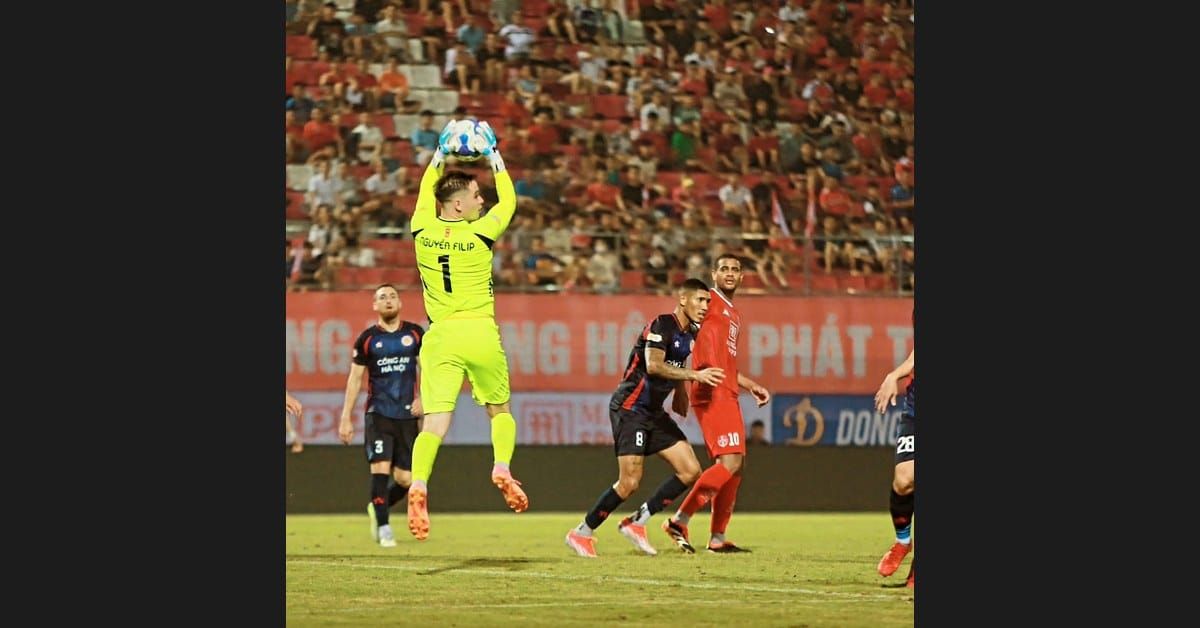
Filip Nguyen was born in Prague to a Vietnamese father and a Czech mother, and for the first two decades of his life Vietnam existed mainly through his father's stories. He visited for the first time at twenty-four. He submitted the paperwork for Vietnamese citizenship in 2019 — not for football, he insists, but because he wanted the dual identity to be official. The approval came on 6 December 2023, more than four years later. By then he had already moved to Hanoi, won a V.League 1 title, and begun the second half of a career spent between Europe and Asia.
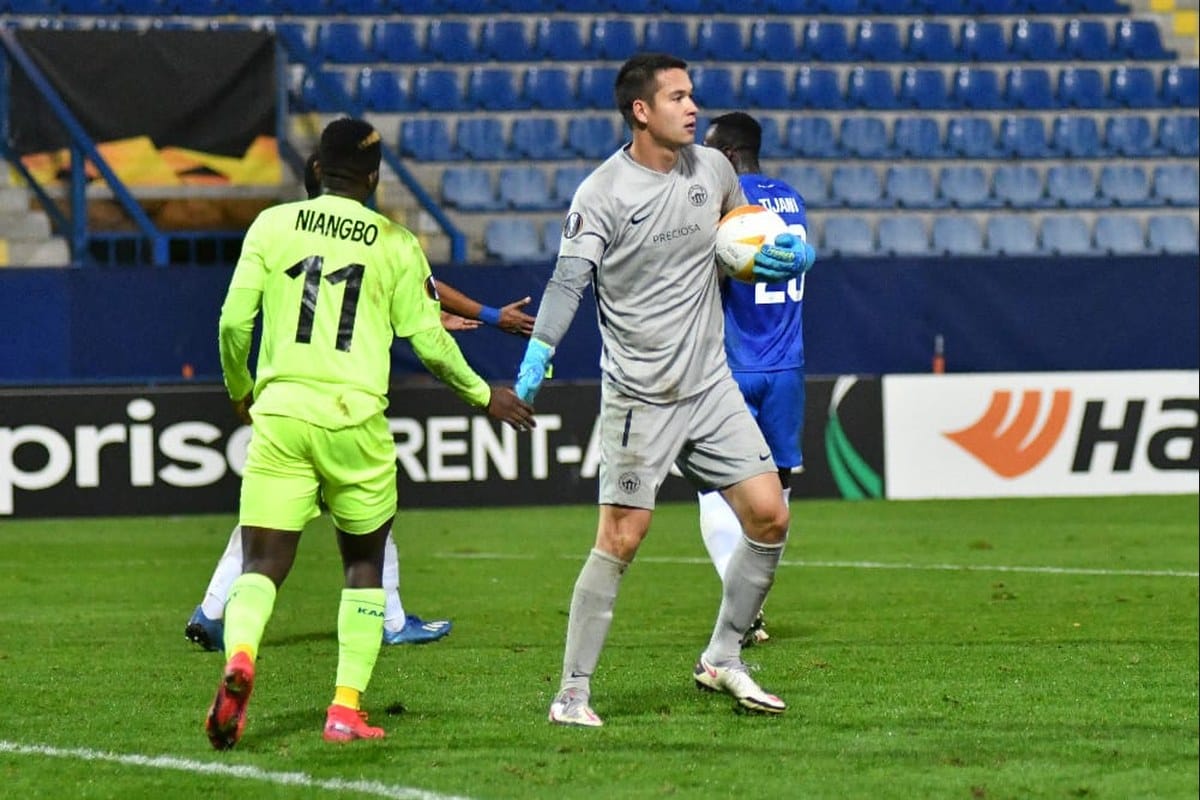
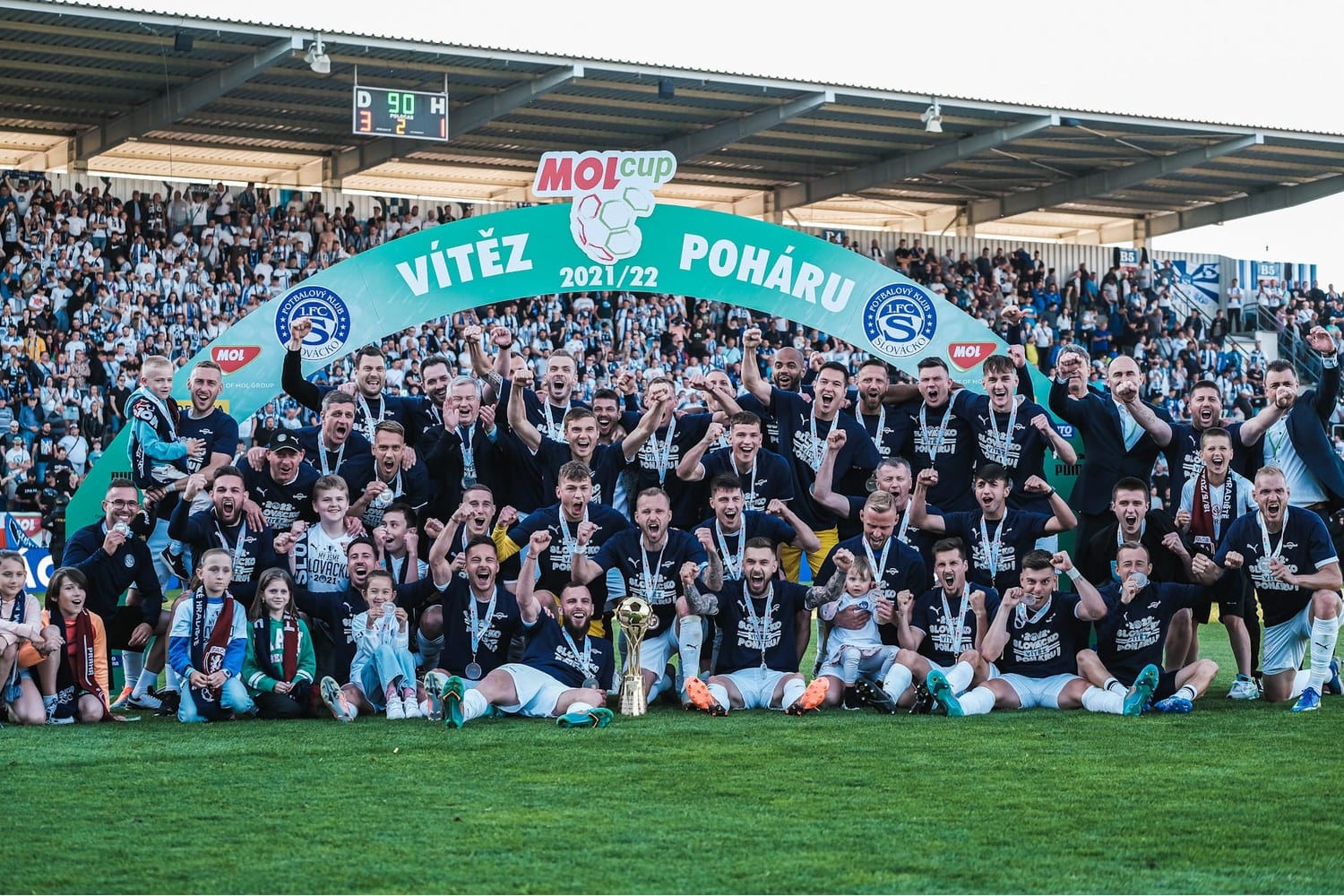
Today he is Công An Hà Nội's first-choice goalkeeper. V.League 1 champion, 2024 ASEAN Championship winner with Vietnam, named to the 2025-26 V.League 1 Team of the Season, and currently inside the AFC Champions League Elite group stage with his club. Before that came fourteen years in the Czech game: Sparta Prague's youth system from 2009, a Bohemian League step through SK Union, a loan at Vlašim in the Czech Second League, two seasons at Slovan Liberec that produced his first UEFA Europa League and Europa Conference League appearances, and a return to 1.FC Slovácko that produced the 2021-22 Czech Cup — his first senior trophy.
The timing of his move matters for Korean readers. He signed with Công An Hà Nội in July 2023, as Park Hang-seo's six-year chapter in charge of Vietnam was closing and Vietnamese football was asking what came next. His club's current ACL Elite campaign is the first in which K League 1 sides and Vietnamese champions share a group-stage calendar as routine opposition rather than one-off novelty. The meeting point between Hanoi and Jeonju, between a V.League champion and a Korean top side, is now one away match on the schedule.
We asked him about positioning as "an art" (his word), about the shift between playing short-passing at Công An and playing cautious at Slovácko, about why he refused to withdraw the citizenship application through four years of silence, and about how a trophy lifted in a Vietnamese shirt differs from one lifted in a Czech one. His answers are grounded and unhurried. One line in particular stayed with us: "I don't fully fit in here or there, but I see it as having two homes, and I'm completely at peace with that."
What follows is a written exchange, published in his own words and in the order he answered them.
CURRENT CLUB
Công An Hà Nội FC (V.League 1, Vietnam) · No. 1 goalkeeper · contract until June 2029 (2023–present)
NATIONAL TEAM
Vietnam senior squad · 13 caps · 2024 ASEAN Championship winner · previously called up to the Czech Republic senior squad (no appearances)
PLAYING CAREER
- 2023–present · Công An Hà Nội FC (Vietnam, V.League 1)
- 2020–2023 · 1.FC Slovácko (Czech Republic, First League) · UEFA Europa League & Europa Conference League
- 2018–2020 · FC Slovan Liberec (Czech Republic, First League) · UEFA Europa League
- 2015–2018 · FK Jablonec (Czech Republic, First League)
- 2014–2015 · FC Sellier & Bellot Vlašim (Czech Republic, Second League, loan)
- 2013–2014 · SK Union Čelákovice (Czech Republic, Bohemian League)
- 2009–2013 · AC Sparta Praha (youth)
CAREER HIGHLIGHTS
- V.League 1 champion × 2 · Vietnamese Cup winner · Vietnamese Super Cup × 2 (Công An Hà Nội)
- 2024-25 ASEAN Club Championship runner-up (Công An Hà Nội)
- 2021-22 Czech Cup winner (Slovácko) · first senior trophy
- 2024-25 and 2025-26 V.League 1 Team of the Season
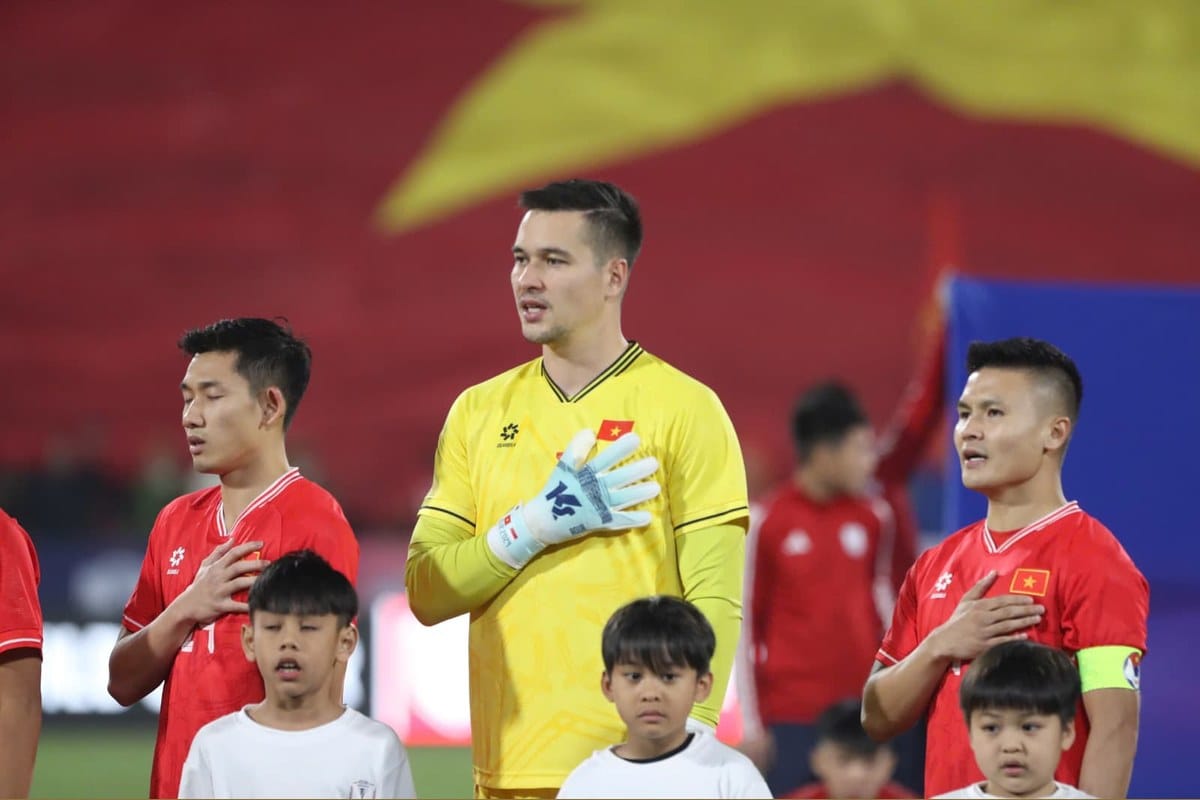
- 2024 ASEAN Championship winner (Vietnam national team)
CONTINENTAL COMPETITION APPEARANCES
- UEFA Europa League (Slovan Liberec, Slovácko)
- UEFA Europa Conference League (Slovácko)
- AFC Champions League Two (Công An Hà Nội)
- AFC Champions League Elite (Công An Hà Nội, 2025-26 group stage)
PLAYING STYLE
- Positioning-based goalkeeping with emphasis on angle and footwork
- Short-passing build-up and distribution
- Defensive organisation and in-match communication
PERSONAL
- Born 14 September 1992, Prague, Czech Republic
- Vietnamese father (from Hải Phòng) and Czech mother
- Vietnamese citizenship approved 6 December 2023
- Languages: Czech (native), English, learning Vietnamese
REFERENCE
- Transfermarkt profile
PART 1 · BEGINNINGS
Filip Nguyen, welcome. If you were to define yourself as a goalkeeper in a single sentence, what would you say?
Thank you. Those kinds of questions are very difficult for me because I see myself differently than others... but I would say I'm a team player who always tries to support others and always has their back.
PART 2 · THE TECHNICAL ARCHITECTURE OF GOALKEEPING
A height of 192 cm gives a goalkeeper dominance in aerial duels, but at the same time physical stature can limit reaction speed when dealing with low-trajectory shots or tight near-post angles. What principles do you use to balance these advantages and disadvantages in your goal-line positioning and footwork, and can you paint a picture of one moment on the pitch where that principle was at work?
Every weakness can be compensated for with the right tool. For example, if a goalkeeper is short, they can easily handle high balls through proper positioning, courage, and timing. With my height, agility can of course be an issue, but I can prepare for low shots with the right body posture and good footwork. The key to everything is proper positioning. Saves then look effortless, but standing at the right angle is an art.
"The key to everything is proper positioning. Saves then look effortless, but standing at the right angle is an art."
The 2022–23 Czech First League record for most clean sheets is a product not of a goalkeeper's reflexes alone but of communication with the entire defensive structure. What was the most important element in your communication system with the Slovácko back line that season, and can you give one concrete moment when that element prevented a goal?
At that time, I had very experienced defenders in front of me. The leader of the defense was Michal Kadlec — with experience from the Turkish league, the Bundesliga, and the national team. We were led by a coach who was meticulous about tactics and defense, which made my job so much easier. Overall, we clicked on a personal level as well, and that chemistry carried over onto the pitch, as reflected in our results.
Single-word instructions were always enough, and it was immediately clear what I needed from the defense. We perfected blocking shots from distance: the defender would always cover the near post, and I took care of the rest. Or inside the box when everyone was packed near the goal, we would quickly call out who was defending which side, allowing us to cover more space together.
The modern goalkeeper is responsible for the first pass in build-up play. When the opposition's forward press is high, what are your criteria for choosing between a long ball and a short pass, and did those criteria change between the Czech First League and V.League 1? If so, what variables drove that difference?
At our club, it's simple. We always try to play short. Of course, in the league it's easier because opponents don't have the same intensity and organization as in the AFC Champions League Elite. In the Czech Republic, playing short is harder because tactical organization there is at a high level as well, and coaches preferred to "play it safe."
Another difference, of course, is the role my club plays in the league. At Công An Hà Nội, we are the dominant team, so we dictate the style of play. In the Czech Republic, that wasn't the case — there were "higher-quality" teams than us, and we were under much more pressure.
The goalkeeper has the widest field of vision on the pitch. When reading the opponent's attacking development and issuing real-time instructions to your defense, what cues do you prioritize first: the body orientation of the opposing striker, the tempo of the midfielder's passing, or shifts in wide areas? How do you determine that priority?
Of course, I have to assess what poses the immediate threat. Usually, that's whatever is closest to the goal.
For example, a striker making a run behind the defense — I want my defenders to track him. Or crosses from wide areas — we have to mark the attackers inside the box and block the delivery. Is the striker within shooting range? A defender has to step up and block the shot.
You have played 43 matches in the Czech Second League, 138 in the Czech First League, and 82 in V.League 1. The hierarchy of abilities required of a goalkeeper must have differed in each league — which abilities did you complete first, which are you still refining now, and what was your reasoning behind that order?
For a goalkeeper, it's more or less always the same. The main goal is not to concede. Of course, with a higher level comes higher speed, quality, and pressure. At first, it's important to build the confidence that you truly belong at that level. Then you gain experience and realize that what you've learned in training can actually be applied in matches.
Believing in yourself is key; once a goalkeeper has the quality, the biggest part of performance is mental. Of course, football evolves, and I try to keep up with modern trends and adapt my technique to what modern football demands — especially when it comes to positioning in goal.
PART 3 · THE DESIGN OF STEPWISE GROWTH
You joined Sparta Praha's youth system in 2009 but did not receive a first-team opportunity until 2014. How did you assess the reasons you did not cross the threshold to Sparta's senior squad at that time, and what was the most important lesson that period left for your subsequent career planning?
I got the opportunity to train with the first team, which was a massive experience for me. Back then, they were one of the best teams in the Czech Republic, regularly playing in European competitions. In training, I saw that I could comfortably hold my own against those players. It gave me huge motivation and confidence.
On the other hand, it showed me how incredibly tough it is to claim a starting spot in goal, or even the backup position. It made me realize that it isn't always just about performance — football is primarily a business, and if you don't have sharp elbows, it's going to be very hard to make it.
You rose one level every two years: 22 matches in the Bohemian Football League in 2014, 43 in the Czech Second League in 2016, 78 in the Czech First League from 2018. At each transfer juncture, what were your criteria for judging that you were ready for the next stage, and did you have a yardstick for confirming that state of readiness?
I've always believed that I could reach a higher level. I was always ambitious, and I still am today.
For me, it was like being in the gym. You do the bench press and load up the bar, then for the next set you try adding more weight and you still lift it. So you add even more weight on the next set, and you can still handle it. That's exactly what it was like for me. It took a little time to adapt to each new level, but I was always able to match it and even surpass it.
I love challenges, and I love it even more when people doubt me and I prove them wrong.
"I love challenges, and I love it even more when people doubt me and I prove them wrong."
Your transfer fee rose tenfold, from a €40,000 loan fee to Slovácko in 2021 to a €400,000 transfer fee to Hà Nội in 2023. What factors do you believe determine a goalkeeper's market value, and what was the decisive element that multiplied your transfer fee by ten?
I've never paid attention to market values on Transfermarkt — I don't think they reflect a player's real value. At one point, my value there was listed at €900,000, but when the club received an offer of over a million euros, they still turned it down. A player's price is simply whatever another club is willing to pay.
For Công An Hà Nội, I was an attractive prospect because no other player of Vietnamese origin had ever played in the Europa League or Conference League. I had even been called up to the Czech national team, but since I never actually made an appearance, there was still the potential for me to play for the Vietnamese national team.
PART 4 · THE CHOICE OF NATIONALITY AND IDENTITY
You were born in Prague to a Vietnamese father and a Czech mother; your father's hometown is Hải Phòng. What did Vietnam mean to you in childhood, and what inner transformation led from that to your decision to apply for Vietnamese citizenship in 2019?
I used to only hear about Vietnam through stories from my dad. The first time I visited was when I was about 24 years old. Back then, it never crossed my mind that I would play football here, but I wanted to obtain citizenship for my personal life as well. I've always been proud of having roots in both countries, and this would make it official.
My dad and I worked on it for over eight years, but it only happened after I made the transfer and moved to Vietnam.
More than four years elapsed between the start of your Vietnamese citizenship application in 2019 and its approval on 6 December 2023. During that uncertain period, when the possibility of national-team selection was opaque, why did you not withdraw the application, and where did your sense of belonging lie during that time?
Actually, it took much longer than four years. As I said, when we first submitted the application, it had nothing to do with football — I just wanted to officially hold dual citizenship.
Whenever I was in the Czech Republic, I felt different from other Czechs, and people viewed me differently too. The paradox is that now that I'm here, I feel the exact same way. People here don't really see me as Vietnamese either... I don't fully fit in here or there, but I see it as having two homes, and I'm completely at peace with that.
"I don't fully fit in here or there, but I see it as having two homes, and I'm completely at peace with that."
You were first called up to the Czech Republic national team in September 2020 and received several more call-ups, but never played. There were also reports at the time that you had declined to appear. What was the real reason behind that decision, and were you already contemplating the Vietnamese national team then?
I don't know where that was written, but it's not true. I would never refuse to play in a national team match. For an athlete, it's the ultimate achievement.
When we were playing a World Cup qualifier in Belgium once, our goalkeeper got injured right at the start and the coaches went with the other keeper at the last second. I was really disappointed and angry. But that exact moment was probably crucial, because if I had played back then, I wouldn't have been able to play for Vietnam later. Thanks to that, I had the opportunity to play in the Asian Cup.
And even if that turns out to be my last major tournament, I'll be satisfied because it's a huge accomplishment. Everything happens for a reason, and only time will tell how things truly turn out.
The 2024 ASEAN Championship title was the first trophy you lifted in a Vietnamese shirt. For a player who had experienced the 2021–22 Czech Cup triumph in a Czech shirt, how did the trophy lifted in Vietnamese colors differ from the one in Czech colors, and where did that difference come from?
I didn't play many matches in this tournament, so I feel this success belongs to others and I don't take much credit for it. Of course, I'm disappointed that I couldn't contribute more, especially after seeing how happy and proud it made the people here, but that's football — sometimes you're just not the first choice.
In the Czech Republic, I played a bigger part and we were underdogs, so it was an even greater achievement... Nevertheless, when you win a trophy for an entire country, it's that much sweeter.
PART 5 · V.LEAGUE ADAPTATION AND ORGANIZATIONAL CONSTRUCTION
You signed with Hà Nội in July 2023, at the age of 30. You were young enough to continue in Europe — why did you choose V.League, and when you made that choice, which weighed more heavily: sporting conditions or the prospect of citizenship?
My family played a crucial role. I wanted the kids to grow up somewhere other than the Czech Republic, so they could learn languages and experience different cultures. Plus, Vietnam will be their second home as well. I knew my chances of obtaining citizenship would be higher and that I would be able to play for the national team.
On top of that, transfers to a better league had fallen through several times because the clubs couldn't reach an agreement, which left me disappointed. I also knew that my chances of success here were high — I could win trophies and showcase myself to all of Asia.
You began with 8 appearances in your first season and became Hà Nội's undisputed number one by the 2025–26 season with 22 matches. Was there a turning-point match or moment in the process of securing your place as Hà Nội's first-choice goalkeeper, and if so, when was it and what changed in that moment?
I wouldn't point to one specific moment. For goalkeepers, the key is delivering consistent performances across the entire season. Of course, you have better games and worse games, but it should never drop below a certain standard. From my perspective, I've always managed to maintain that, and I think that's reflected in the results over the last three seasons.
You were named to the 2025–26 V.League 1 Team of the Year. If there was something clearly different in your performance that season compared to the previous one, was it a technical change or a shift in decision-making or defensive organization? What conditions brought about that change?
To be honest, I wouldn't really say anything has changed. In both seasons I was among the top goalkeepers for clean sheets — it's just that last season we won the title, so it probably looked better.
There were reports that you struggled with the Vietnamese heat in your debut against Đà Nẵng on 2 July 2023. Vietnam's climate can be a challenge for European-born players — how does that condition now affect your in-match output and recovery routines, and have you developed any daily routines or principles to manage it?
It is a really big issue. The humidity and hot weather do not let you train at your full potential. I felt the difference when we played the qualifying play-off in Australia during their winter. I felt I could train and play much more than in Southeast Asia during the summer. You cannot breathe as easily as normal, and you get tired much faster. Of course, you need to adjust your recovery routines and use proper supplements.
PART 6 · COMPARING CONTINENTAL COMPETITIONS
You have experience in the UEFA Europa League and Conference League, and are currently playing in the AFC Champions League Elite. Do the match tempo and the character of pressing that a goalkeeper faces differ between European club competition and Asian club competition? If so, how are you responding to that difference?
I think the biggest difference between us and top teams in the AFC Champions League Elite is tactical discipline. In Europe, teams were at a similar tactical level, but the biggest difference was in the individual quality of players. Here in Vietnam, we have quality players, but they are not as tactically developed. Another problem is that our domestic league cannot prepare us for the required intensity because we stop the game too much, whereas in the AFC, referees let the game flow much more and we cannot keep the pace for the whole match.
Hà Nội finished runners-up in the 2024–25 ASEAN Club Championship, and you featured in that campaign. What are the tactical characteristics of Southeast Asian club competition, and can you paint a picture of one scene that captures the situation you most frequently face as a goalkeeper on that stage?
In the Shopee Cup, I think there's still a big performance gap between the teams. Take our group, for example: Buriram and Borneo. With all due respect to all the clubs, the difference in quality is simply there.
That said, I think it's a good tournament because you get to test yourself against teams from comparable countries in Southeast Asia. Every match is completely different, and I really like the quality of the organization. I just wish more fans would come out to these games.
PART 7 · FUTURE AND LEGACY
You are contracted to Hà Nội until June 2029, when you will be 36. What is the greatest goal you wish to achieve before retirement, and how do you hope the goalkeeper Filip Nguyen will be remembered in Vietnamese football after you hang up your gloves?
I hope people in Vietnam will remember me as someone who helped to develop football in Vietnam, and my biggest goal is to win a trophy on the international stage.
"I hope people in Vietnam will remember me as someone who helped to develop football in Vietnam."
CLOSING
What makes Filip Nguyen's story particular is not the dual citizenship, which many players share, but the lack of resolution he admits to inside it. He is comfortable not fully belonging in either place. He describes it as peace rather than compromise, and he does not reach for a reconciliation he does not feel. In practice, that posture has carried a goalkeeping career from a Sparta Prague youth setup where he could not quite break through, to a Czech Cup trophy with Slovácko, to a Vietnamese passport that arrived more than four years after he applied for it, and now to a Hanoi dressing room preparing for an ACL Elite campaign that will measure Vietnamese champions against opposition they rarely see on this stage. The craft underneath all of it is unglamorous and specific — positioning as an art, single-word defensive instructions, blocking the near post and taking care of the rest, short-passing because "we are the dominant team, so we dictate the style of play." He is not performing a goalkeeper's identity. He is doing a goalkeeper's work.
The Korea thread sits inside that larger ledger more quietly than it will in future years. Among the opponents Nguyen's club now meets in continental play, inevitably, are K League 1 sides. The 2025-26 ACL Elite group stage runs into 2027. By the time his current contract ends in June 2029, Vietnamese top sides and Korean top sides will have met in continental group play often enough that the comparison stops being novelty and starts being data. His own answer to the question of legacy is short and modest — I hope people in Vietnam will remember me as someone who helped to develop football in Vietnam, and my biggest goal is to win a trophy on the international stage. Both are still ahead of him. ACL Elite is where the first version of the test lives — and the first time, over 180 minutes against a K League opponent, that a Vietnamese champion will have to decide, not with words but with results, who the better team actually is. Football Agent Lab will be watching, with a quiet hope that one of the chapters still ahead of him is written on this side of the East Sea.
ABOUT THE AUTHOR (gray callout)
SEOK LIM — Editor · Football Agent Lab
FIFA-licensed football agent and steel market analyst with over a decade of experience in commodity research. Football Agent Lab publishes interviews and market reports at the intersection of football, agency work, and global markets.


