Teaching Situations, Unlocking Creativity — Domingo Oramas
From Las Palmas to Ecuador, India and now Australia, Domingo Oramas has spent twenty years teaching players to read the game. The Spanish methodology coach joins Football Agent Lab for a deep tactical exchange on positional play, "chasing the shadow" — and what his work could bring to the K League.
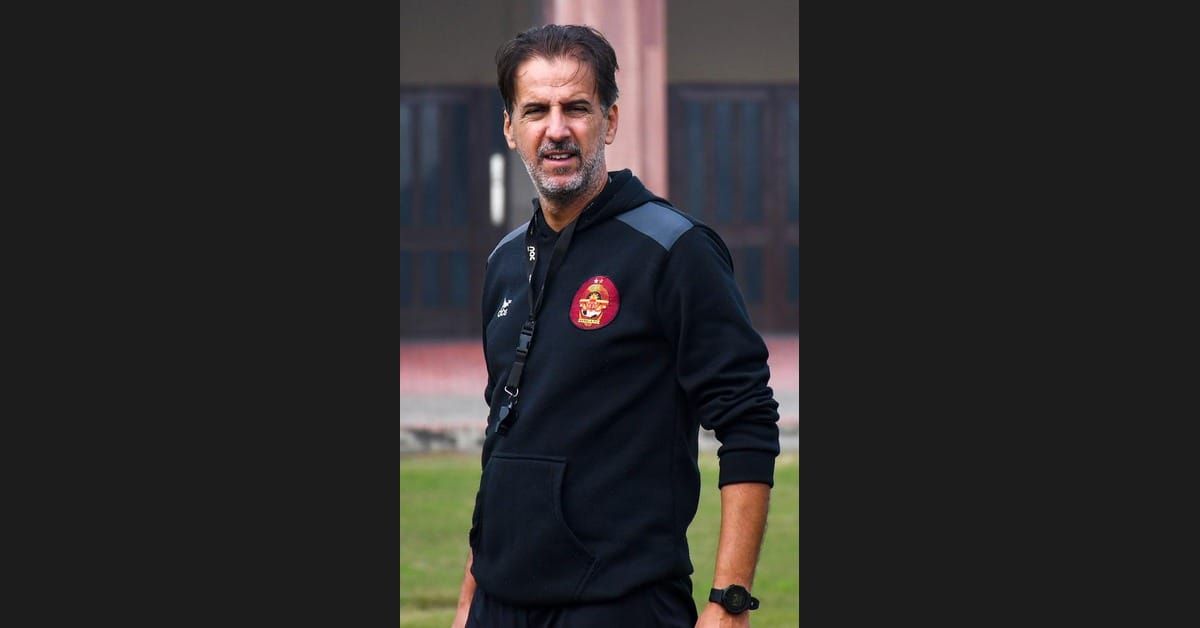
Ask Domingo Oramas to define himself and the answer is short: "a coach focused on helping his players understand the game in order to improve collective behaviour — a hardworking, honest, and demanding coach." Behind that plain sentence is one of the more travelled coaching lives in this series. Over more than twenty years, the Spaniard has moved through Spain's lower divisions and a LaLiga bench, one of Ecuador's most celebrated youth setups, two seasons as a head coach in India's I-League, and now the A-League, where he is assistant coach at Central Coast Mariners. It is his first written exchange with Football Agent Lab, and it is the most tactically detailed the series has run.
The pedigree is real. Across ten seasons at UD Las Palmas he won seven U19 league titles and worked as methodology director and first-team assistant to managers including Quique Setién; at Independiente del Valle he was part of the development and scouting pathway that produced Moisés Caicedo, Piero Hincapié and Willian Pacho; with modest CD Mensajero he beat Real Madrid Castilla at Valdebebas. But the interview lives in the detail of his method — "chasing the shadow" to occupy an opponent's blind side, releasing the third man, reading when to circulate and when to attack depth, designing set pieces down to the timing of a single run, and building an individual development sheet for every player. Running under all of it is a conviction he states flatly: football is about people before it is about systems.
Late in the conversation the questions turn to Korea, and he meets them head-on. Having transplanted Spanish positional play into a different football culture in India — adapting principles to the people rather than copying a model — he lays out, concretely, what that experience could add to the K League: not replacing Korean football's intensity, discipline and athleticism, but complementing them with tactical understanding and a clearer academy-to-first-team pathway. It is, for readers of this publication, an unusually direct answer to an unspoken question. And it sits inside a career whose stated goal is not trophies but the people left behind: better players, better coaches, clubs stronger than he found them.
Football Coach · Methodology · Youth Development · Analysis
CURRENT ROLE
Assistant Coach · Central Coast Mariners (Australia · A-League) · 2026–present
COACHING CAREER
Sreenidi Deccan FC (India · I-League) — Head Coach · 2024–2025
Gokulam Kerala FC (India · I-League) — Head Coach · 2023–2024
UD San Fernando (Spain) — Head Coach & Football Director · 2020–2021
Independiente del Valle (Ecuador) — Assistant Football Direction, Development Coach, Scout · 2018–2019
CD Mensajero (Spain) — Head Coach · 2017–2018
UD Las Palmas (Spain) — Methodology Director & First-Team Assistant · 2016–2017
Las Palmas Atlético (Spain) — Head Coach · 2014–2016
UD Las Palmas U19 (Spain) — Head Coach · 2007–2013
Unión Viera CF (Spain) — U19 Head Coach · 2004–2007
SELECTED WORK
UD Las Palmas, 10 seasons — seven U19 league titles; assistant to Setién, Herrera and Lobera
Independiente del Valle — part of the pathway for Caicedo, Hincapié and Pacho
CD Mensajero — wins over Real Madrid Castilla, Real Sociedad and Athletic Bilbao
India (two I-League clubs) — positional-play methodology, wins over ISL clubs, performance department built from scratch
Players developed — Jonathan Viera, Vitolo, Juanpe
METHODOLOGY
Positional play · "chasing the shadow" & third-man combinations · collective pressing and transition
Set-piece design · cognitive training (perception–decision–execution) · individual development sheets
Club football-identity building · academy-to-first-team integration · data as decision-support
LICENCES & AWARDS
UEFA Pro Licence · Technical Director · RFEF award for coaching career (2014)
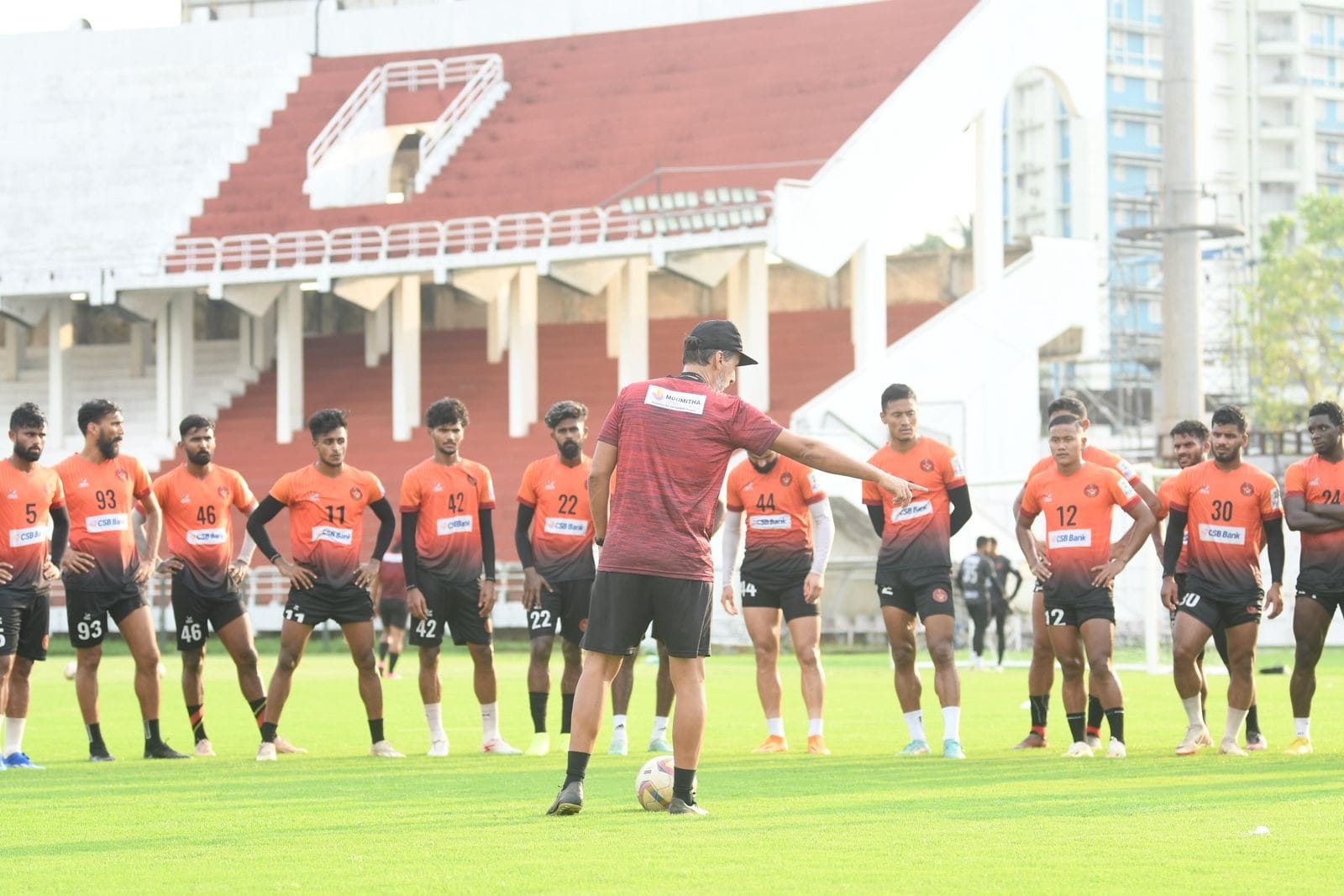
PART 1 · THE PLAYER, FIRST
Starting out in Spain's third tier, you've moved through a LaLiga bench, one of Ecuador's most prestigious youth setups, and India's I-League, and now you've arrived at Australia's A-League — across more than twenty years, the language and the continent have changed several times over. And yet you seem never once to have let go of a single goal: to make the player understand each moment of every match and arrive at a better decision. If you had to define Domingo Oramas — the coach who has carried that thread through all of those places — for Korean readers in a single sentence, what would it be?
A coach focused on helping his players understand the game in order to improve collective behaviour. A hardworking, honest, and demanding coach.
Four pillars hold up your methodology: the player, the team, training, and competition — with the order anchored by the principle that the player matters most, and that everything is focused on developing him. On the professional stage, where results reign, this people-first arrangement can risk looking like idealism. Could you paint a single scene of how this principle comes alive on an ordinary day at the training ground — from the very moment the players walk in each morning?
I understand that the development of the game depends on the player's understanding of it. We need to provide them with tools that help improve the model. There are four pillars that support a model which will be refined with each training exercise. We place great importance on every action in the game and on every training exercise.
PART 2 · CHASING THE SHADOW
The five elements of attack — passing, space, depth, finishing, and width — interlocking with the five elements of defence — order, aggression, discipline, pressing, and intensity — turning like the symbol for infinity: that image appears to be the skeleton of your game model. Over ninety minutes, though, these two phases don't flow together so seamlessly, and cracks always appear at the seams. If a spectator were watching the moment of transition — from attack to defence, and back from defence to attack — what would it look like to them?
Indeed, both aspects of the game are intertwined; we must be prepared for that transition from the mental to the attitudinal. The first few seconds of that transition period are crucial. I like to see the team react collectively to recover the ball after losing it, or to attack spaces after regaining possession.
You've repeatedly stressed that you regard the pass not as the simple movement of the ball but as a channel of communication, and you've emphasized the picture of the player in possession drawing an opponent in, facing him down, then advancing through a third player. This is clearly a different grain from the current obsession with possession figures. Could you explain, frame by frame — right down to the players' lines of sight and the direction of their feet — a single build-up beginning from the back that splits the opposition's line through that third player?
This sequence perfectly defines my footballing DNA and the training methodology I have developed over two decades in elite football. I do not value possession as an empty statistical metric; rather, I see it as a tool to manipulate and disorganise the opponent through the language of the pass. This exact concept of drawing pressure to release the third man is something I worked on meticulously during my 10 seasons at U.D. Las Palmas, watching coaches such as Quique Setién and IDV in particular, while collaborating alongside Miguel Ángel Ramírez in the Academy, a manager renowned for this specific philosophy.
You've called the four to five seconds immediately after losing the ball decisive, and said that the press in that very moment is what reveals the aggression your team seeks in its state without the ball. Yet this instant recovery is a double-edged sword: threatening when it works, but surrendering the entire space behind when it fails. Could you paint together how all eleven players react during those four seconds — and what conditions must be in place on the pitch for this press not to collapse?
The players closest to the ball are key; collective pressing is fundamental. The first step is to change the mental attitude once possession is lost, so that it can be recovered as quickly as possible. To achieve this, our main objective is to cut off passing lanes, pressure the ball carrier, and reduce space, thus avoiding having to track back.
Among your expressions for the build-up, "chase the shadow" is one that particularly stays with me. This concept — of exploiting the space outside the opponent's field of vision, behind his back, to create an advantage — reads as the key to drawing an opponent in and breaking his line during possession from the back. Could you unfold, as one concrete scene, the moment a centre-back receives the ball, pulls an opposing forward out, and uses that shadow to neutralize the press with a single pass?
The objective is not simply to complete a pass; it is to manipulate the opponent, create superiority and progress through the pitch under control.
We train these situations repeatedly so that players don't just memorise movements — they learn to recognise the cues and make the right decision according to the opponent's behaviour. Football is about manipulating opponents, not only moving the ball.
Imagine our left centre-back receives the ball and the opposition striker presses him. Instead of playing immediately, he draws the striker by carrying the ball for a few metres. As the striker commits to the press, he leaves space behind him and loses sight of the holding midfielder. The ball attracts the opponent, and the opponent creates space. Our job is to recognise where that new space appears. We don't pass because someone is free; we first make him free by attracting pressure. That's what I mean by chasing the shadow. It's about occupying the opponent's blind side, eliminating a defender with one pass and continuing the attack with positional superiority.
We don't pass because someone is free; we first make him free by attracting pressure.
In transition, you place great value on judging when to exploit and run into the space the opponent has left, and you've said you train depth heavily in particular. The patience that positional play demands and the instantaneous explosion that the counter-attack demands often stand at opposite poles. Could you demonstrate, as a single scene, how a player distinguishes between "now is the time to circulate the ball and wait" and "now is the time to run in behind" — and how that judgment operates on the pitch?
Imagine we recover the ball in midfield. The first thing our players do is scan. If the opponent is well organised, with the defensive line compact and the spaces behind closed, there is no reason to force the attack. In that situation, we keep possession, circulate the ball and reposition ourselves to create better conditions. We stay patient because possession is also a way of controlling the game.
But if, after winning the ball, we recognise that the opponent's defensive line is unbalanced — for example, one centre-back has stepped out, the full-back is high, or there is a large space behind the last line — then the priority changes immediately. That is the moment to attack the depth.
Our forwards don't run just because we have the ball; they run because the space is available. The timing of the run is crucial. If the run is too early, the defender can recover. If it is too late, the opportunity disappears.
So the key principle is simple: we don't choose between positional play and transition. We read the game. If the opponent gives us space, we attack it immediately. If not, we keep the ball, reorganise and create the right moment to progress. The decision always belongs to the players, based on what they perceive on the pitch. Football is about recognising opportunities, not forcing actions. Our players learn to read the game first, and then choose the best solution. Sometimes the best pass is forward, and sometimes the best pass is the one that allows us to attack a few seconds later.
You regard set pieces as hugely important in the modern game, citing discipline, the element of surprise, and situational control as their core, and you've made them a significant axis of your methodology. When facing an opponent of far greater quality in open play, a set piece often becomes the weapon that overturns that gap in a single stroke. Recalling one of your victories over a strong ISL side in India, could you draw the moment one of your own designed set pieces caught the opponent off guard and was completed as a goal — starting from the players' positioning and the first movement?
Yes, I remember that goal very well. It was in the Durand Cup against Kerala Blasters, and it perfectly reflects how we work on set pieces.
Before the match, we analysed how they defended corners. We identified their marking structure, the players they relied on in the air and the spaces that appeared when defenders followed runners. Our objective was to manipulate their defensive organisation rather than simply deliver the ball into the box.
We started with a compact setup to disguise our intentions. As the corner was delivered, two players attacked the near-post area to attract defenders and create movement inside the box. At the same time, Bouba delayed his run slightly before attacking the space that opened between the penalty spot and the far-post area.
The quality of the delivery was important, but the key was the coordination of the movements and the timing of Bouba's run. Everyone had a specific role. Some players were creating space, others were occupying defenders, and Bouba attacked the free zone at exactly the right moment to score.
That goal was not the result of improvisation. It was the result of analysis, repetition on the training ground and the players' understanding of why each movement was made. That's why I believe set pieces can be decisive, especially against teams with greater individual quality. They give you the opportunity to create an organised advantage in a very short moment. For me, a successful set piece starts long before the corner is taken. It starts with analysis, continues with detailed preparation during the week, and finishes with players executing the movements with perfect timing and conviction.
PART 3 · DISCOVER, DON'T MEMORISE
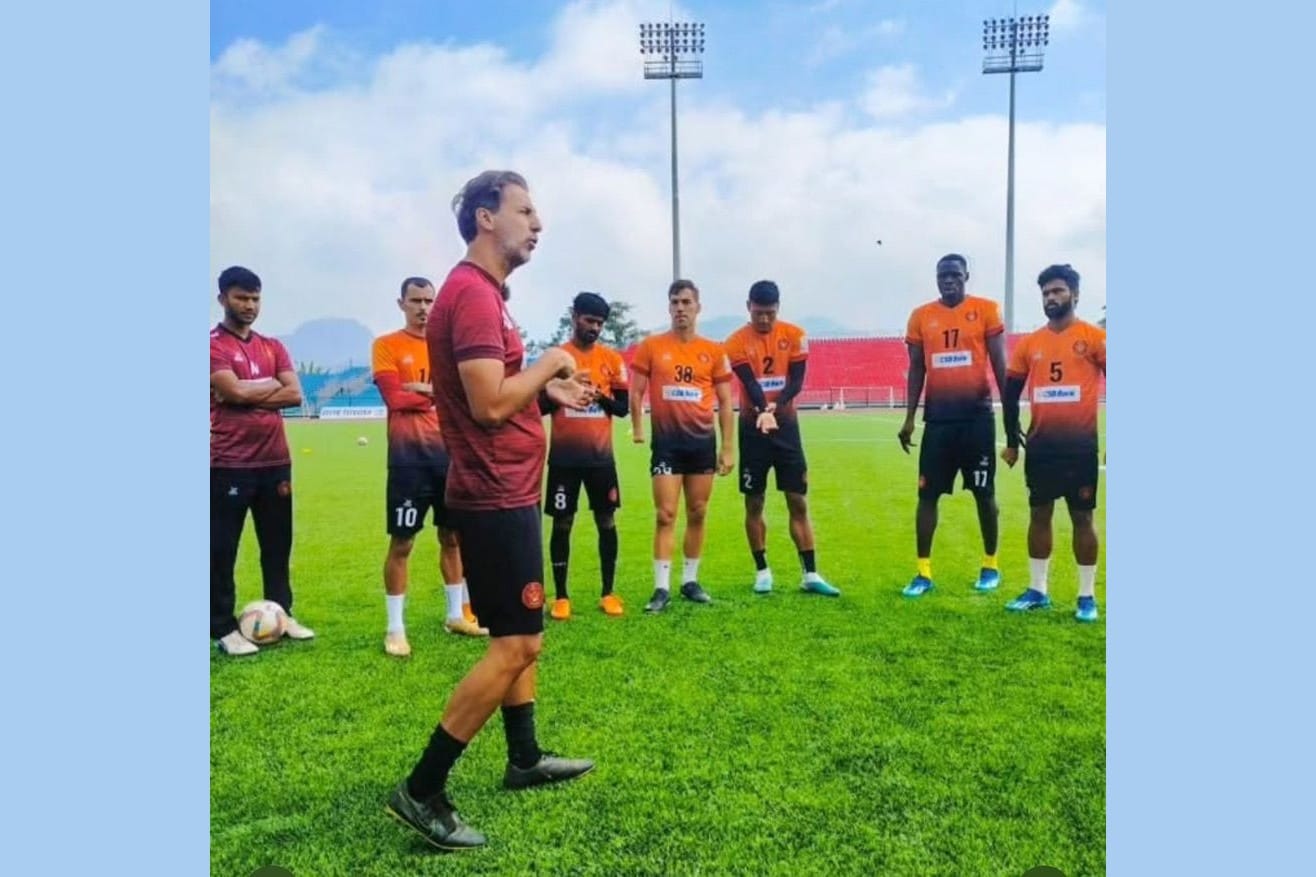
You've defined the essence of training as the development of the cognitive process — perception, decision, execution — and said that you guide the player to find his own answers through open tasks that offer more than one option. Yet this approach, which withholds the answer in advance, carries the risk of drifting into confusion and wasted time. Could you draw a single session from start to finish — how one such open task is actually set up on the training ground, and how you intervene until the player arrives at his answer?
That's a very good question, because I believe players don't learn by being told the answer; they learn by solving the game. However, that doesn't mean the coach becomes passive. Our role is to design the environment and guide the learning process.
For example, let's imagine we are working on playing through the opponent's first line of pressure. We set up an exercise with two centre-backs, a holding midfielder and a full-back against three pressing players. The objective is not simply to keep possession, but to find a way to break the first line and progress into the next zone.
I don't tell the players, 'Pass to the number six' or 'Use the full-back.' Instead, I let them experience different situations. Sometimes the solution is to attract the press and play inside. Sometimes it's to use the third man. Sometimes it's to switch play. The task offers several correct solutions because that's what happens in a real match.
During the exercise, I don't stop play after every mistake. I observe first. If I see that the same problem appears repeatedly, I intervene with questions rather than answers. I might ask, 'What made that pass difficult?' or 'Where was the free player?' or 'What happened when the striker jumped to press you?' Those questions encourage the players to reflect and find the solution themselves. The objective of training is not to create players who remember solutions. It is to create players who can discover solutions every weekend.
The objective of training is not to create players who remember solutions. It is to create players who can discover solutions every weekend.
You've built an individual development sheet for every player to identify strengths and weaknesses, and set as your goal drawing out each individual's highest level within a collective structure. Individual freedom and team discipline are forever a taut tug-of-war. Could you unfold, as one case, how a single weakness written on a player's sheet was translated into a concrete task within the team's tactics and eventually turned into a strength — right down to what was written on that sheet?
I'll give you a real example. We had a young central midfielder with excellent technical quality and passing range, but on his individual development sheet we identified one important weakness: he was receiving the ball too often with a closed body shape. That meant he usually needed an extra touch before playing forward, and under pressure he often had to play backwards.
On his development sheet, one of the objectives was: 'Receive with an open body shape to play forward whenever possible.'
We didn't work on this in isolation. We integrated it into our team training. During positional games and build-up exercises, we designed situations where he constantly had to scan before receiving, adjust his body position and identify the free player. We increased the pressure progressively so that the habit became effective under real game conditions.
After every session, we reviewed video clips together. We didn't only analyse mistakes; we also highlighted successful actions so he could recognise the difference between receiving closed and receiving open.
After a few weeks, the improvement was clear. He was breaking lines more often, playing forward with fewer touches and helping the whole team progress more efficiently.
For me, that's the key. Individual development should never be separated from the team. We improve individual qualities because they make the collective stronger, and the collective gives players the context to express their individual strengths.
You've said that you control everything through analysis software such as NacSport and through GPS, stats, and databases — while at the same time insisting that you must first know the player as a person and approach him with an open mind. The balance between the numbers and the human is never simple. When the data points to leaving a player out but your eyes tell you to trust him, what decision did you actually make? Could you explain with one case?
For me, data is a decision-support tool, not a decision-maker. GPS, statistics and video analysis give us valuable information, but they never replace the coach's understanding of the player.
I remember one case where a player's physical data suggested he wasn't at his normal level. His high-speed running and total distance during the week were lower than usual, and from a purely analytical perspective, the safest decision would have been not to start him.
Instead of relying only on the numbers, I spoke with him. I wanted to understand how he was feeling physically and mentally. He explained that he had managed his training load because of some muscular fatigue, but he felt fresh and confident for the match. During training, my observations confirmed that his decision-making, intensity and body language were exactly what I expected.
I decided to trust him, and he started the game. He performed very well, because the data had highlighted a risk, but it didn't tell the whole story.
That's why I always combine objective information with subjective observation. Data tells me 'what' is happening, but conversations and daily interaction help me understand 'why' it is happening. Only by combining both can you make the best decision for the player and for the team.
In the end, football is played by people, not by numbers. Technology is a powerful tool, but it should support human judgement, never replace it.
At Las Palmas, as Methodology Director, you created new training methods themselves; at San Fernando, holding both manager and football director roles, you professionalized the club's departments and built the finest U23 player database in Spain. You are, in effect, both the manager on the bench and the eye that designs the system. If you were to rebuild a club's football philosophy from the ground up, what is the very first button you'd fasten, and why? Could you unfold it concretely?
The first button I would fasten is not the game model. It is creating a shared football identity throughout the club.
Without a common methodology, every department works in a different direction. The first thing I do is define clear principles that everyone understands — from the first team to the academy, from the coaches to the performance and analysis staff. Every decision should support the same football idea.
When I worked as Methodology Director, and later combining the roles of Head Coach and Football Director, my first objective was to create that common language. We established training principles, individual development processes, reporting systems and regular communication between departments.
For example, if the first team wants proactive players who can play under pressure and make good decisions, then the academy must train those same behaviours. Recruitment must identify those profiles, the analysts must evaluate those principles, and the fitness department must prepare players for that style of football.
Only after that foundation is in place do I focus on tactical details or specific systems of play. Systems can change from one season to another, but the club's football identity should remain consistent.
That's why I always say that methodology is not a document. It's a way of working that connects every department with one common objective: developing better players and building a competitive team with a clear identity.
At Sreenidi Deccan, you founded a new performance department and applied a video-analysis process to training and matches, establishing a structured high-performance environment. Unlike Europe, where the infrastructure and culture are already in place, the challenge on a stage where you must build it all up from scratch is surely of a different nature. Could you paint the first sign — what scene it was — when a performance department, born in a place where there had been nothing, actually began to turn?
The first sign wasn't a report or a GPS number. It was a player's behaviour.
When we started, many players saw video analysis as something that only happened after a match, usually to point out mistakes. Performance data was something the staff looked at, not the players.
So we changed that mindset. We introduced short individual video sessions, clear performance objectives and regular feedback after both training sessions and matches. Everything was simple, practical and directly related to improving performance.
After a few weeks, something changed. One morning, before the analysis meeting even started, one of the players came to me and asked if we could review one of his actions from the previous game because he wanted to understand if he had made the right decision.
For me, that was the turning point. At that moment, performance was no longer something imposed by the staff — it had become part of the players' mentality. They were taking ownership of their own development.
From then on, the department wasn't just collecting information. It was influencing behaviour. That's when I knew we had started to build a genuine high-performance culture.
Technology, GPS and video are important, but they are only tools. The real success comes when players actively seek feedback because they want to improve. That's the moment when a performance department truly begins to make a difference.
PART 4 · CLOSING THE GAP
During your time at Independiente del Valle, as a development coach and scout, you were involved in the growth of players who are now Chelsea's Caicedo, Arsenal's Hincapié, and Paris Saint-Germain's Pacho. Back when they were still unknown prospects, something others couldn't see must have caught your eye. When you first watched Caicedo in those days, what single scene convinced you that "this player is different"? Could you paint it for us?
I was assisting with UDI training sessions under the academy director, Miguel Ángel Ramírez. The level of Independiente del Valle's players is very high, as can be seen in the current national team. I spent many years coaching the UD Las Palmas U19 team and played in many Spanish Championships, and I can tell you that that IDV U18 team was extremely strong, with players like Pacho, Caicedo, Hincapié, and others.
In your Mensajero days, on the stage of Spain's Segunda División B, you produced historic wins — beating Real Madrid Castilla at Valdebebas and overcoming Real Sociedad and Athletic Bilbao. When a side overwhelmingly inferior in resources and reputation topples a giant, it is usually the manager's preparation that bridges the gap. Choosing one of those matches, could you unfold — like a scenario — what weakness in the opponent you read, and with what plan you armed your players?
I would choose our victory against Real Madrid Castilla at Valdebebas, because it perfectly illustrates how preparation can reduce the gap in quality.
Before the match, we analysed their game in detail. We knew they were technically excellent and wanted to dominate possession, especially through their midfield. But we also noticed that when their full-backs pushed high, there were moments when the spaces behind them were exposed during transitions.
Our plan was not to defend deep for ninety minutes. We wanted to stay compact, close the central spaces and force them to play where we wanted. Then, the moment we recovered the ball, we attacked quickly into the spaces left by their advancing full-backs.
During the week, we trained those situations repeatedly. We worked on our defensive organisation, the timing of the press and, most importantly, the first pass after recovering possession. We wanted that first pass to eliminate pressure and immediately attack depth with our wide players and forwards.
The players understood the plan perfectly. They remained disciplined without the ball, trusted the process and recognised the right moments to attack.
For me, that match confirmed something I have always believed: preparation does not eliminate the opponent's talent, but it can reduce its impact. If your players understand the game, stay organised and exploit the right moments, you can compete against teams with greater individual quality.
At San Fernando, you took over a side sitting in the relegation zone mid-season, transformed them into the strongest team of the second half of the campaign, lifted them to fifth in the league, and the following year reached the promotion play-off final. Walking into a broken team and turning its direction around within half a year demands something beyond tactics. Could you draw concretely what you changed first — in the dressing room and on the training ground — during your first two or three weeks in charge?
When I arrived, my first priority was not changing the formation. My first priority was changing the mentality.
The team was in the relegation zone, so confidence was very low. The players were thinking too much about the table and not enough about their daily work. My first message was simple: we stop talking about results and start focusing on behaviours that we can control every day.
During the first two weeks, I met every player individually. I wanted to understand not only the footballer, but also the person. I needed to know what they were feeling, what they believed the team's problems were and how I could earn their trust.
On the training ground, we simplified everything. Instead of introducing too many tactical concepts, we focused on organisation, defensive compactness, intensity without the ball and clear principles in possession. I wanted every player to know exactly what was expected in every phase of the game.
Training sessions became very competitive. Every exercise had an objective, clear rules and accountability. At the same time, we created a positive environment where players felt confident to compete again.
Little by little, the players started believing in the process. Results followed because confidence returned through daily work, not through speeches.
For me, changing a team's direction always starts with changing its culture. Once the players trust each other, trust the staff and understand a clear way of playing, tactical improvements come much more naturally. That's how we went from the relegation zone to becoming one of the strongest teams in the second half of the season and reaching fifth place.
PART 5 · CLARITY UNDER PRESSURE
Learning how to win through a systematic training structure — a view that sees victory not as the product of talent but as the product of structure. Yet no matter how much structure you build, the moment always comes when a match slips from the plan and begins to fall apart. That moment on the sideline when you sense the flow tipping away and reach out to act — could you show us, drawing an actual match's half-time dressing room, right down to your first words and the first diagram on the board?
I remember one match where we started well, but after about thirty minutes I felt the game was moving away from us. We weren't losing because of effort; we were losing because our distances had become too long. We were pressing individually instead of collectively, and the opponent was finding free players between our midfield and defensive lines.
When we went into the dressing room, I didn't start by talking about attitude or emotion. My first words were: 'Calm down. The game is still exactly where we want it, but we have to solve one problem together.' I wanted the players to stay clear-headed before discussing tactics.
Then I went to the tactics board and drew two horizontal lines representing our midfield and defensive units. The first thing I wrote was one word: 'Distances.'
I showed them that when our striker pressed, the midfield was arriving two or three seconds too late. That gap was giving their number ten too much time to receive and turn.
The adjustment was very simple. We reduced the distance between our lines by five or six metres, pressed as a unit instead of individually, and changed the pressing trigger. Instead of jumping every time the centre-back received the ball, we waited for the pass into one side before pressing aggressively together.
We didn't change the whole game model. We changed one behaviour that was affecting everything else.
In the second half, we recovered possession much higher up the pitch, controlled the spaces between the lines and completely changed the momentum of the game.
For me, half-time is not about giving twenty new instructions. It is about identifying the one or two key problems that explain everything else. If the players leave the dressing room with absolute clarity, they can solve the game themselves.
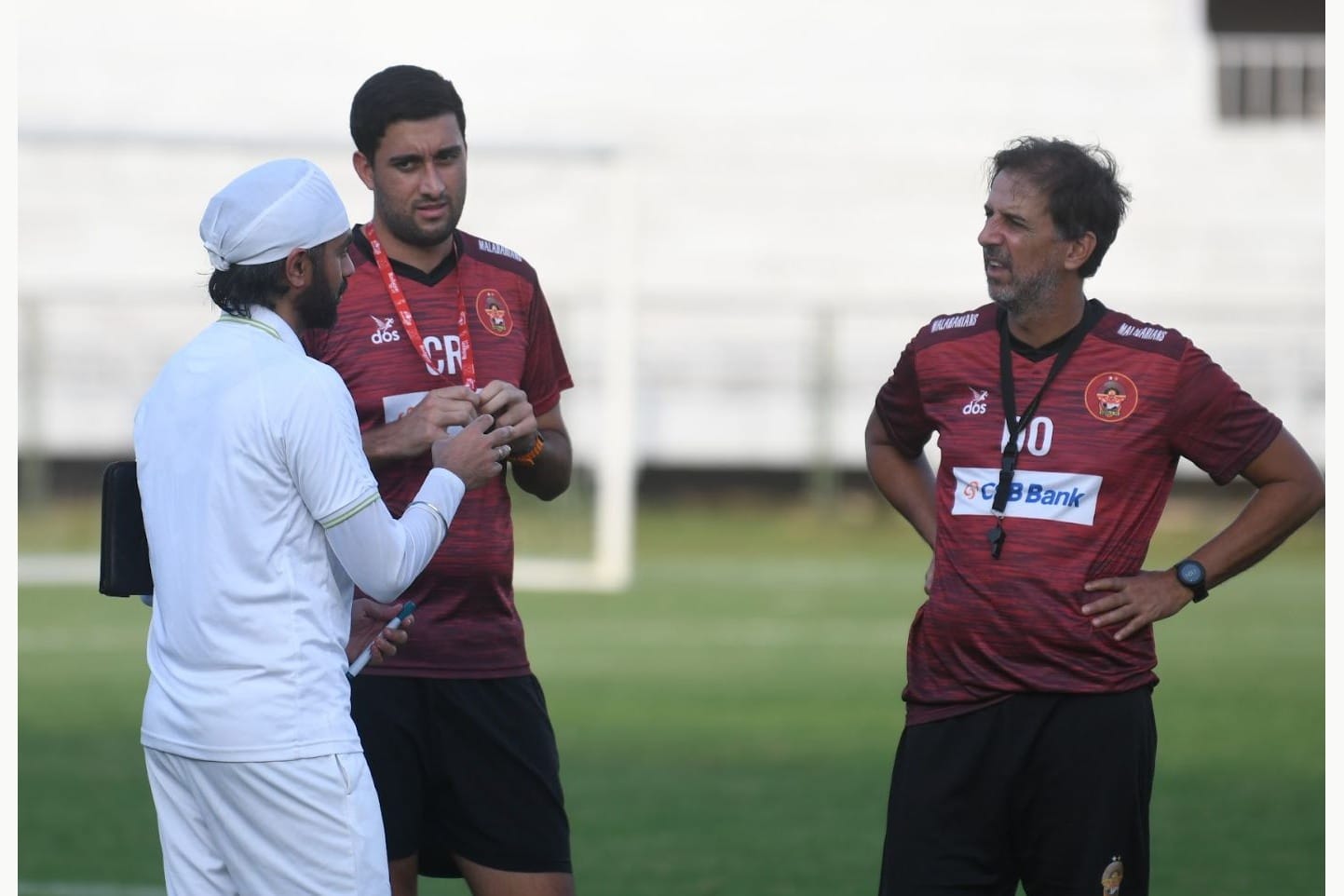
You've long stressed that teamwork is the key to success, emphasizing daily staff meetings; and having assisted managers such as Quique Setién and Sergio Lobera at Las Palmas, then leading your own team as manager, you now sit on the bench once more as an assistant at Central Coast Mariners. To know both the seat of ultimate responsibility and the seat that supports it is an uncommon asset. What is the one thing a good assistant coach must always do for his manager, and what role are you actually playing on the A-League bench right now? Could you unfold it in a single scene?
Having worked in both roles has taught me something very important. The assistant coach is not there to confirm every decision of the head coach. His responsibility is to help the head coach make better decisions.
The most important thing an assistant coach can do is tell the truth, even when it is uncomfortable. Of course, it has to be done with respect and always behind closed doors. Once a decision has been made, the whole staff must support it completely in front of the players.
During the week, I work on training design, tactical planning, video analysis and individual player development. We discuss opponents in detail and prepare different scenarios before every match.
During the game, my role is to observe what is difficult to see from the head coach's perspective. While he is managing the flow of the game and communicating with the players, I am constantly analysing our structure, the opponent's adjustments and the spaces that are beginning to appear.
For me, that's the essence of being an assistant coach. You don't compete with the head coach — you complete him. Your responsibility is to provide another perspective, anticipate problems and help the staff make better decisions under pressure.
Because I have been a head coach myself, I understand the weight of the final decision. That experience has made me a better assistant, because I know exactly when to offer an opinion, when to challenge an idea constructively and when to fully support the decision that has been made. The best assistant coach is not the one who speaks the most. It's the one who sees what others don't see and helps the head coach make clearer decisions. In the end, there is only one objective: helping the team perform better.
PART 6 · FROM INDIA TO THE K LEAGUE
Taking the helm for two consecutive seasons in India's I-League and beating strong ISL sides, you've transplanted the methodology of Spanish positional play into a wholly different Asian football culture. The K League, too, carries the tasks of embedding modern football and forging the link that carries players from youth to the first team — so the points where your journey meets theirs appear to be many. If you were to stand on the Korean stage, what do you believe that experience of "methodology transplantation" gained in India could add to the K League? Could you explain with a concrete picture?
One of the biggest lessons I learned in India is that you cannot simply export a methodology from one country to another. Every football culture has its own identity, its own strengths and its own way of learning. My job is not to replace that identity but to build on it.
When I arrived in the I-League, I didn't begin by introducing complex positional play concepts. First, I wanted to understand the players, their football culture and the characteristics they already had. I realised they had excellent technical ability and were very comfortable in one-versus-one situations, but they needed more collective understanding of space, positioning and decision-making.
So instead of changing everything, we introduced the methodology step by step. For example, in our positional games we didn't focus only on keeping possession. We worked on recognising when to create superiority, when to attack depth and when to keep the ball to control the game. Every exercise had a tactical purpose, but it was always connected to the players' reality and learning process.
Over time, the players didn't just improve tactically — they started to understand why they were making certain decisions. That understanding helped us compete successfully against stronger ISL clubs, because our organisation and collective behaviour compensated for differences in individual quality.
I believe that experience is directly relevant to the K League. Korean football already has many strengths: intensity, discipline, work ethic and athleticism. My role would not be to change those qualities, but to complement them with a structured methodology that develops tactical understanding, decision-making and a clear connection between the academy and the first team.
For me, methodology is never about copying a model. It's about adapting principles to the people, the culture and the club. That's how you create a sustainable football identity.
Methodology is never about copying a model. It's about adapting principles to the people, the culture and the club.
PART 7 · PEOPLE BEFORE SYSTEMS
At Las Palmas you sent Vitolo, Jonathan Viera, and Juanpe up to the world stage; at Independiente you did the same with Caicedo, Hincapié, and Pacho — betting on young players and leaving a legacy in which many reached the professional and international level. Along this long journey linking Europe, South America, Asia, and Australia, what is the vision and the goal you envision from here? And when the day comes to leave the stage, how do you hope the coach Domingo Oramas will be remembered?
Throughout my career, I have been fortunate to work in Europe, South America, Asia and now Australia. Every country has taught me something different, but they have all reinforced the same belief: football is about people before it is about systems.
My vision is to continue helping clubs build sustainable football identities — not only by winning matches, but by developing players, coaches and working environments that continue to grow long after I have left. I enjoy building structures, creating methodologies and connecting academies with first teams because that creates a lasting legacy.
Looking ahead, I would like to keep challenging myself in different football cultures. Every new country is an opportunity to learn, to share ideas and to help a club develop a clear identity that fits its own culture and ambitions.
When my career comes to an end, I don't hope people remember me because of the number of matches I won or the trophies I collected. I hope they remember me because I helped people become better — better players, better coaches and better professionals.
If one day a former player says, 'I became a better footballer because of what I learned from Mingo,' or a young coach says, 'His methodology changed the way I understand the game,' that would be the greatest success of my career.
For me, football is much more than ninety minutes. It is about education, leadership, curiosity and continuous learning. Results are important, but the legacy we leave in people lasts much longer than any trophy.
That is how I hope Mingo Oramas will be remembered: as a coach who always tried to improve the people around him, who respected every culture he worked in and who left every club stronger than he found it.
Football is about people before it is about systems.
CLOSING
For all the tactical machinery — the shadow, the third man, the four-second press, the set piece drawn to the timing of a single run — the sentence Domingo Oramas keeps returning to is disarmingly simple: football is about people before it is about systems. It is not a soft note tacked onto a hard method; it is the method. His training withholds the answer on purpose, because he wants players who can "discover solutions every weekend" rather than recall them. His data stops at the door of judgement, because "football is played by people, not by numbers." Even his account of rebuilding a relegation-bound San Fernando starts not with a formation but with meeting every player, one by one.
What gives the conversation its edge for readers here is that he does not leave Korea as a hypothetical. Asked directly, he answers directly: the lesson India taught him was that you build on a football culture rather than overwrite it, and he maps that lesson onto the K League without flattery or overreach — Korean football's intensity and discipline are the foundation; what he'd add is tactical understanding and a real academy-to-first-team pathway. Coming from a coach who helped shape Caicedo, Hincapié and Pacho, and who has now carried his methodology across four continents, it is less a pitch than a considered offer. Whether Korean football takes him up on it is another story; the case, at least, is on the table. Football Agent Lab will be watching where the road runs next — and, this time, the K League is on it.
ABOUT THE AUTHOR
SEOK LIM Editor · Football Agent Lab
FIFA-licensed football agent and steel market analyst with over a decade of experience in commodity research. Football Agent Lab publishes interviews and market reports at the intersection of football, agency work, and global markets.


